
Evidence Report: “Marshawn Mujica” and Digital Blackface, SCDC Retaliation, and the May 2026 Smear-and-Suppression Campaign Against Kevin “Rashid” Johnson and UPROAR
By: UPROAR Admin · June 5, 2026Necessary background on the smear campaign and prison retaliation behind Rashid’s current solitary confinement.
Prepared by Evi Magnolia
Rashid criticized Jeanes indirectly in an article about Ben Crump’s grift. Jeanes then threatened that Rashid would “regret it” if Rashid mentioned him, said he had collected recordings, and explicitly threatened to involve law enforcement. Days later, SCDC punished Rashid for published writing, including Rashid’s article about Jeanes. This report documents how Jeanes took an old SCDC allegation that UPROAR had already explained to him as retaliation against Rashid’s prison journalism — and that Rashid was already challenging in federal court as part of SCDC’s campaign to silence him — stripped away that context, and used it to smear Rashid as sexually dangerous, discredit his criticism, attack UPROAR infrastructure, mislead a grieving family-support space, and help create conditions in which prison officials could silence an incarcerated Black journalist for answering him.
This is not only historical background. Rashid is currently being punished in South Carolina custody. UPROAR has set up a campaign page where supporters can call officials, send the Action Network letter, report completed actions, and share the emergency campaign:
Take action to free Rashid from retaliatory solitary and bring him home to Virginia.
That old allegation was not new, and Jeanes knew its context. In May 2025, UPROAR circulated an advocacy update explaining that SCDC had accused Rashid of “exposure” only after Rashid published about SCDC abuse, only after outside pressure intensified, only after an SCDC Inspector General official allegedly threatened him over supporters’ calls and emails, and after Rashid filed a PREA grievance saying a woman sergeant had looked into his cell while he was using the toilet. Jeanes and Dawn read that update.
Rashid’s pending civil rights complaint says the same basic thing in litigation form, and in sharper detail. The complaint alleges that SCDC officials treated solitary confinement as a “forewarning” of what Rashid would suffer if he continued media exposure, critical journalism, litigation, and public attention campaigns; that after he published about his South Carolina transfer and treatment, an SCDC Inspector General official threatened him over outside calls, media contact, and articles about SCDC; that officials used a fabricated sexualized allegation as a pretext to place him in RHU; and that they then moved him to a non-communication unit to cut off phone and tablet access and prevent further public exposure. In other words, Jeanes did not merely repeat an ordinary disciplinary allegation. He weaponized one of the very allegations Rashid was already challenging in federal court as part of an ongoing retaliation-and-communication-suppression campaign.
One year later, Jeanes removed the retaliation and PREA context and repeated the prison’s framing as if it were neutral proof that Rashid was predatory or discredited. Then SCDC punished Rashid for published writing, including Rashid’s article about Jeanes. The issue is not whether Jeanes personally ordered SCDC to act. The issue is that Jeanes’s outside attack and SCDC’s internal discipline worked in the same direction: discredit Rashid, isolate him, and suppress his ability to answer.
This report explains the background to that current emergency. For the immediate call/email campaign, use UPROAR’s action page: Free Rashid from retaliatory solitary and bring him home to Virginia.
- Executive Summary
- I. Rashid Was Put in Solitary for Published Writing
- II. Jeanes Threatened Rashid Would “Regret It”
- III. The Cease-and-Desist Was a Pre-Emptive Intimidation Tactic
- IV. Jeanes Carried Out the Harassment and Defamation He Accused Others Of
- V. Jeanes and Dawn Knew the South Carolina Allegation Was Retaliation/PREA-Related
- VI. Jeanes Used the Allegation the Same Way SCDC Used It
- VII. The Method: Ignore, Isolate, Discredit, Kill
- VIII. Jeanes Lied to Aubrey McKay’s Family-Support Space
- IX. Jeanes Violated UPROAR’s Code of Conduct and Confidentiality Policy
- X. Jeanes Attacked UPROAR’s Listserv and Supporter Infrastructure
- XI. Sockpuppet Accounts, Marshawn, and Linked Account Infrastructure
- XII. Jeanes and Dawn Redirected UPROAR Facebook Infrastructure
- XIII. Jeanes’s Threat, Rashid’s Lawsuit, and SCDC’s Discipline Converged
- XIV. Racialized Sexual Smear as Carceral Counterinsurgency
- XV. Four Modes of Sabotage
- XVI. The Crump/Aubrey Article Named the Contradiction Jeanes Then Enacted
- XVII. Political Conclusion: Comrades, Not Advocates
Evidence note: Exhibits cited below correspond to the downloadable chronological evidence matrix and supporting image archive linked in the Evidence Reference Method section.
Executive Summary
This report documents a retaliation sequence. Rashid criticized Jeanes’s conduct around the Aubrey McKay campaign and Benjamin Crump’s role in it. Jeanes responded by threatening that Rashid would “regret it” if Rashid mentioned him, sending a cease-and-desist before Rashid publicly named him, spreading prison-generated credibility attacks, and carrying false or misleading claims into UPROAR supporter channels and the Justice for Aubrey family-support space.
Then, on May 13, 2026, the South Carolina Department of Corrections placed Kevin “Rashid” Johnson in solitary confinement at Perry Correctional Institution. According to Rashid’s May 20 recorded statement, SCDC did not initially tell him why he was being taken to solitary. Two days later, after his attorney contacted SCDC officials about legal property he needed for court deadlines, SCDC served him with a disciplinary charge for “maintaining a social networking site.”
The disciplinary basis was not a contraband phone or a newly discovered security threat. The incident-report pages show that SCDC relied on two published articles: one article Rashid had written about Jeanes, and one December 2025 UPROAR article about Rashid’s ongoing mistreatment under Interstate Compact confinement in South Carolina.
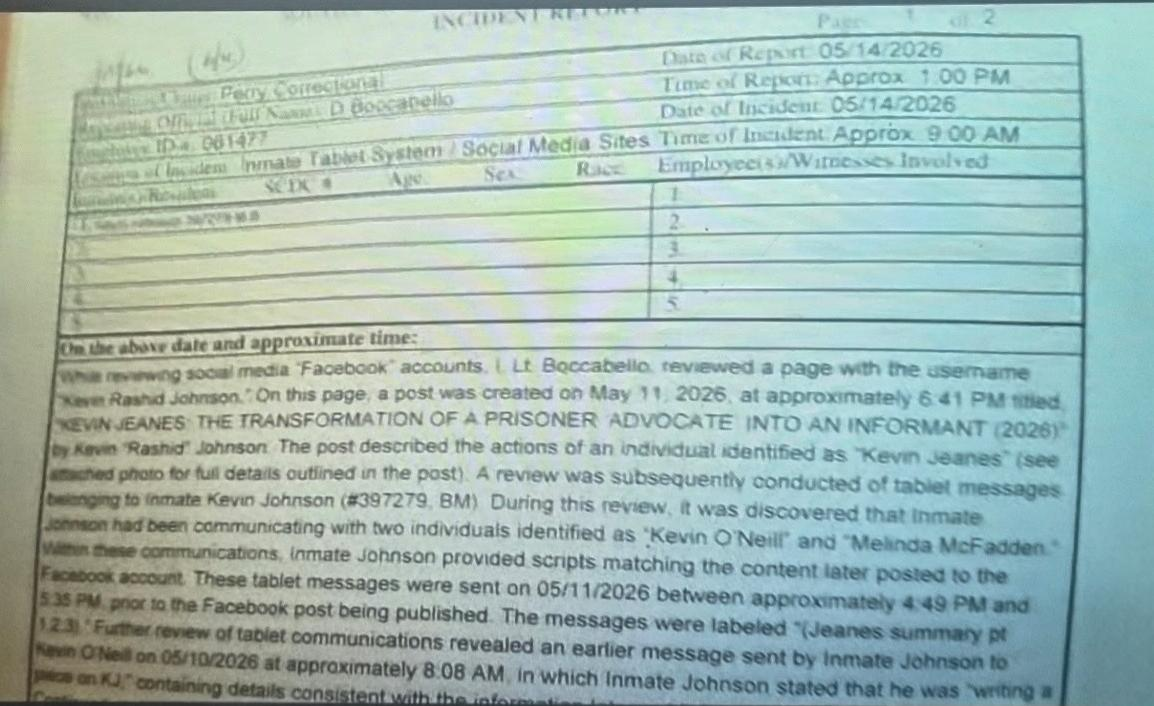
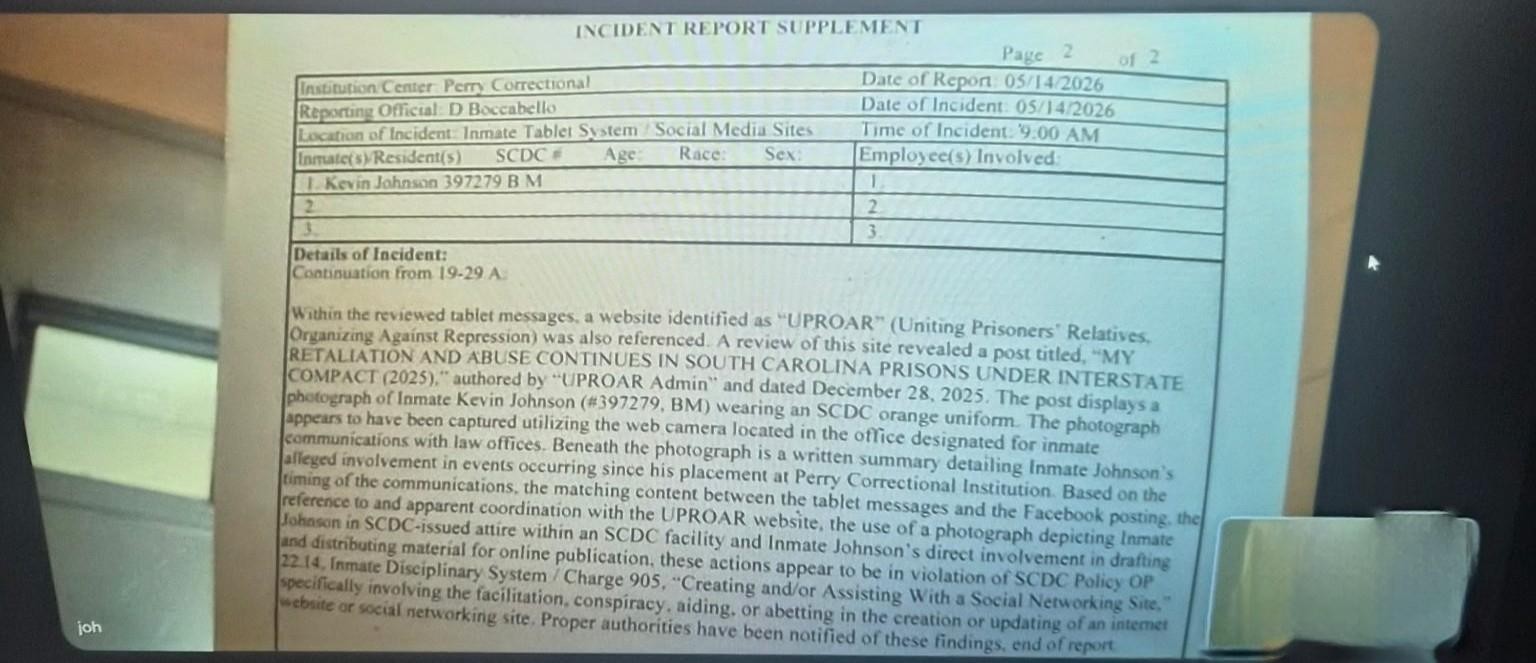
Together, these pages confirm that SCDC charged Rashid for published political writing: one article answering Jeanes, and one article documenting SCDC retaliation.
The timing is central. Jeanes threatened that Rashid would “regret it” if Rashid mentioned him. Rashid then published an article about Jeanes. SCDC then charged Rashid based partly on that article. At the same time, Rashid already had a pending federal civil rights lawsuit alleging that SCDC and VDOC officials were retaliating against him for journalism, litigation, public complaints, and outside communication. In his May 20 statement, Rashid says the hearing officer who found him guilty on the new charge was a defendant in that same lawsuit.
This report does not claim that Jeanes directly ordered SCDC to discipline Rashid – we can’t know for sure whether he made good on his threat to involve authorities. The evidence does not need to show that to show the political character of Jeanes’s behavior nor the dangers it poses to prisoners and their loved ones. Jeanes’s outside campaign and SCDC’s internal discipline converged. Jeanes attacked Rashid’s credibility outside while SCDC attacked Rashid’s ability to answer inside. SCDC cut off Rashid’s communication while Jeanes’s smear campaign gave people a reason not to listen to him.
The core finding is this:
That is not accountability. It is retaliation.
This report also centers Rashid’s own analysis of the state’s method. In “Ignore, Isolate, Discredit, Kill,” Rashid explained that prison officials respond to effective exposure by isolating the critic and attacking his character. That article specifically answered Kyle Gibson’s VADOC quote claiming Rashid had “zero credibility” because of institutional charges and alleged sexual aggression. Jeanes later circulated that same Gibson quote. He did not merely imitate the prison system’s method; he adopted its exact allegations and credibility frame, boosting VADOC and SCDC’s authority in order to lower Rashid’s credibility and raise his own.
Jeanes and Dawn Bryant knew the South Carolina allegation was not a “new” sexual-misconduct issue, as Jeanes dishonestly framed it to grieving loved ones, and they knew it occurred within a high-intensity sequence of racist prison brutality against Rashid in retaliation for his exposure of prison abuse. They had read the May 2025 UPROAR advocacy update explaining that the allegation arose after Rashid published about SCDC abuse, after public pressure and outside calls, after an SCDC Inspector General threat, and after Rashid filed a PREA grievance asserting that a woman sergeant had looked into his cell while he was using the toilet. Records show that both Dawn and Jeanes participated in past email campaigns that acknowledged that retaliatory suppression of Rashid’s rights; neither Jeanes nor Dawn have presented any new evidence that counters that past framing, but both participated in reviving these allegations
Rashid’s pending civil rights complaint reinforces this context. The complaint alleges that his May 14/15 article about his transfer to South Carolina generated public complaints, that SCDC Inspector General agent Fergoli threatened him over outside calls and articles, that the sexualized report was fabricated as a pretext, and that officials expected he would hesitate to publicize it because of embarrassment.
Jeanes later stripped that context away and repackaged the allegation as proof that Rashid was sexually predatory, dishonest, and discredited. He carried that claim into the Justice for Aubrey family-support space, falsely called the South Carolina allegation “new,” falsely framed UPROAR as taking credit for Aubrey McKay’s public attention, described remaining UPROAR members as toxic, and suggested people block Evi.
Jeanes also attacked UPROAR’s infrastructure. His cease-and-desist was sent into UPROAR supporter/listserv channels. Strike 13th and Harriet Tubman’s Cat then echoed his “taking credit” line through those listservs. A UPROAR-branded Facebook group was later renamed into CCCAN infrastructure, with Dawn listed among admins, after UPROAR’s name, organizing labor, and loved-ones trust had built that space.
The evidence supports the conclusion that Jeanes’s campaign was retaliatory, suppressive, abusive, defamatory, and harassing. It harmed Rashid and Evi, but not only Rashid and Evi. It harmed UPROAR members, loved ones, supporters, listserv recipients, and people organizing around Aubrey McKay’s death. It attacked the trust required for families and prisoners to organize against prison repression.
This report should therefore be read alongside the active emergency campaign page: Free Rashid from retaliatory solitary and bring him home to Virginia.
Evidence Reference Method
This report cites screenshots and image exhibits by chronology number from the evidence matrix. The incident-report pages concerning the Jeanes article and the December 2025 UPROAR South Carolina article are cited as Exhibits #76 and #77.
The full chronological evidence matrix, supporting image archive, Rashid’s pending civil rights complaint, and Rashid’s May 20 recorded statement are available for download or review:
- Chronological evidence matrix (.xlsx)
- Supporting image archive (.zip)
- Rashid’s pending civil rights complaint (.pdf)
- Rashid’s May 20, 2026 recorded statement (.mp3)
The report embeds selected exhibits where they are most necessary to verify the central claims. Exhibits #76 and #77 are emphasized near the beginning because they show SCDC’s disciplinary case relied on two published articles: Rashid’s article about Jeanes and UPROAR’s December 2025 article about South Carolina retaliation. Other exhibits document Jeanes’s threat, cease-and-desist, prior knowledge of the May 2025 retaliation/PREA context, statements to Aubrey McKay’s family-support space, listserv attacks, linked-account activity, and Facebook group redirection.
Where the report discusses the civil rights complaint, it treats those facts as allegations in pending litigation unless otherwise corroborated by other evidence.
I. Rashid Was Put in Solitary for Published Writing
Rashid’s May 20 recorded statement says SCDC abruptly placed him in solitary confinement on May 13, 2026 without initially explaining why. He says that two days later, after his attorney contacted SCDC officials about legal property, SCDC served him with a disciplinary charge written by Lt. Dominique Baca Bello. The charge accused him of “maintaining a social networking site” because officials found two articles online that Rashid had written: one about Jeanes and one December 2025 UPROAR article about Rashid’s South Carolina mistreatment.
Rashid says the December 2025 UPROAR article specifically discussed Lt. Baca Bello as one of the Perry officials trying to stop him from communicating with outside people and frustrating his ability to publish articles about prison conditions. That detail matters because Bello was also the charging officer on the May 2026 “social networking” disciplinary report. In other words, one of the officials criticized in the December article then wrote the charge using that article as evidence against him.
The incident-report pages confirm the two-article basis of the charge.
Exhibit #76 identifies the incident as “Inmate Tablet System / Social Media Sites” and describes a May 11, 2026 Facebook post titled “Kevin Jeanes: The Transformation of a Prisoner Advocate Into an Informant.” The report states that Rashid had sent tablet messages containing language matching the later Facebook post.
Exhibit #77 identifies the UPROAR website and the December 28, 2025 article “My Retaliation and Abuse Continues in South Carolina Prisons Under Interstate Compact.” The incident-report supplement states that the article included a photograph of Rashid in SCDC attire, referenced communications with law offices, described his alleged involvement in events since placement at Perry, and supported the charge that he was assisting with an internet/social-networking site.
Rashid says that after the hearing, he was sentenced to 60 days solitary confinement, followed by 100 days telephone restriction, 100 days tablet/message restriction, 100 days canteen restriction, and 100 days visitation restriction. He described the punishment as a direct attack on journalism and on the public’s right to know what happens inside prisons.
Rashid also states that the hearing officer who found him guilty was a defendant in his pending federal lawsuit against South Carolina and Virginia officials for retaliation against his First Amendment activity. He says she prevented him from presenting evidence, repeatedly cut him off when he tried to question the charging officer, and imposed restrictions that cut off every ordinary means of outside communication.
This was not a neutral “social media” charge. SCDC was punishing political communication: writing about prison abuse, naming officials, and answering an outside attack.
That is the first fact readers need to understand. Rashid did not simply receive discipline during an unrelated interpersonal dispute. He was placed in solitary and stripped of communications for articles that included his response to Jeanes.
II. Jeanes Had Already Threatened Rashid Would “Regret It” If He Mentioned Him
Before SCDC punished Rashid for the article about Jeanes, Jeanes had already threatened Rashid for the act of mentioning him.
The conflict began after Rashid criticized Benjamin Crump’s role and media strategy in the Aubrey McKay case. Rashid’s article did not name Jeanes. Even so, Jeanes reacted as if Rashid had attacked his own authority.
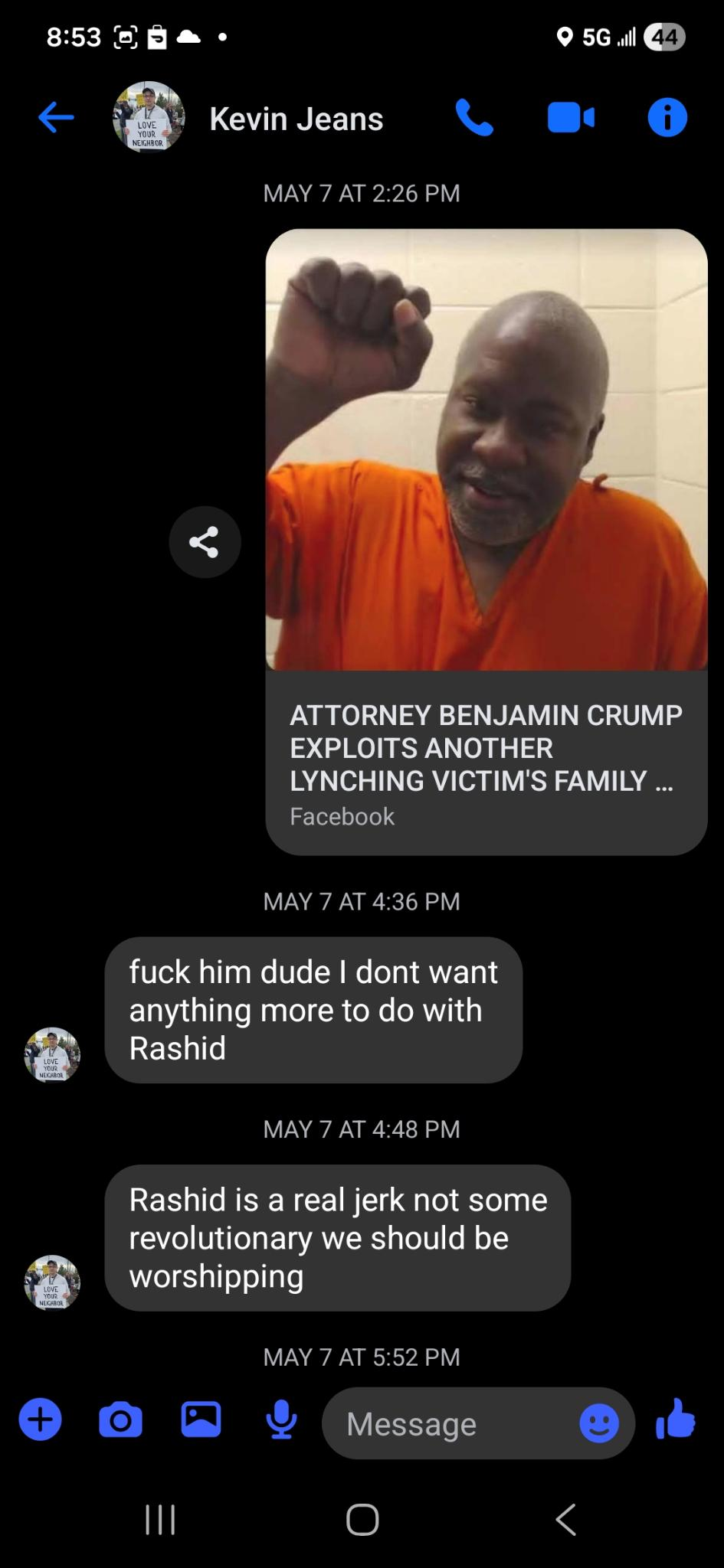
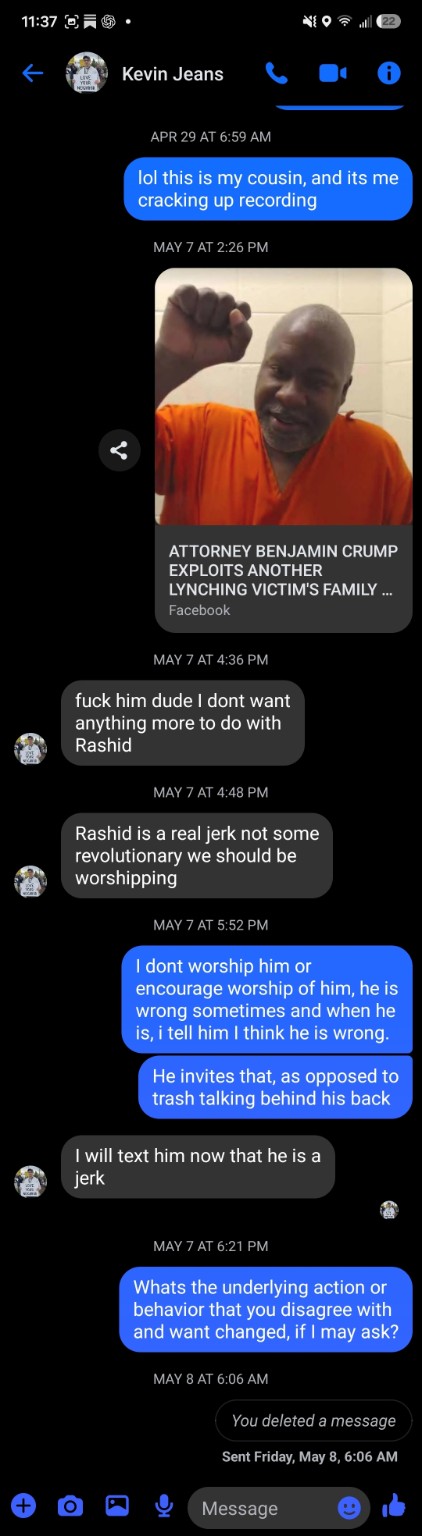
Evi pushed Jeanes toward direct criticism rather than gossip. Rashid then sent one reply through Evi. Rashid’s reply was political criticism, not harassment: he said he invited criticism as a political principle, distinguished principled criticism from gossip, and criticized what he saw as Jeanes’s saviorism, reputation-seeking, and refusal to accept correction from oppressed people.
Jeanes refused to engage the response. He wrote:
“I am not reading this. Dont ever contact me again in his bullshit”
“It tries to contact me or mention me again. I promise he will regret it!”
“Your blocked by the way.”
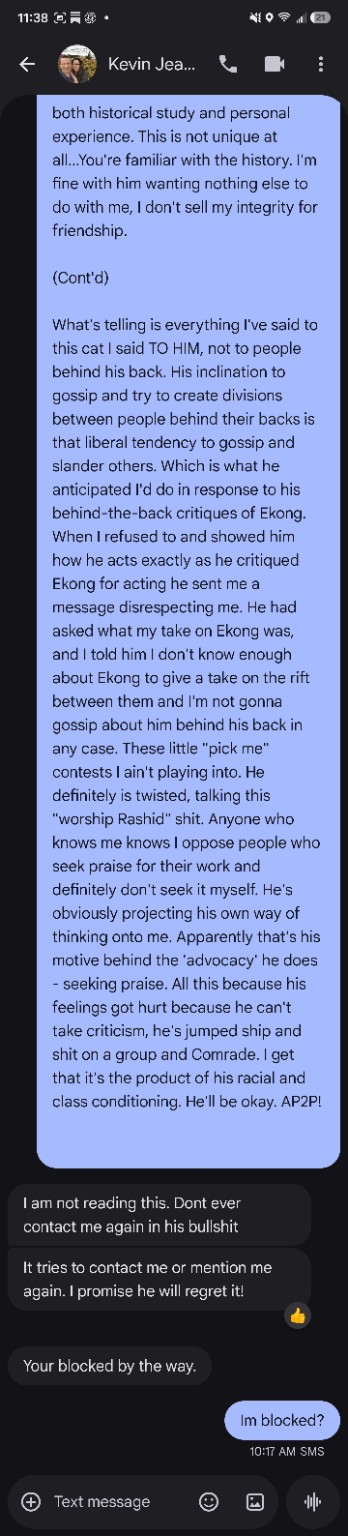
This threat matters for two reasons. First, it came before Rashid published the article about Jeanes. Jeanes was not responding to public harassment. He was threatening an incarcerated critic for even mentioning him. Second, the threat later aligned with what happened: Rashid did mention Jeanes, and SCDC charged him based partly on the article about Jeanes.
The report does not need to claim that Jeanes controlled SCDC. The point is that Jeanes’s threat and SCDC’s punishment converged around the same act: Rashid publicly naming Jeanes.
III. Jeanes’s Cease-and-Desist Was a Pre-Emptive Harassment/Defamation Frame
Jeanes then sent a cease-and-desist before Rashid publicly named him. At that point, the public article in circulation was Rashid’s Crump/Aubrey article, which did not mention Jeanes.

The cease-and-desist was sent from Issaquah Jeans / amoamifamily23@gmail.com, signed Kevin Jeanes, and accused Evi and Rashid of harassment and defamation. It threatened law enforcement, cyberstalking reports, restraining orders, platform complaints, civil claims, and demanded evidence preservation. It was sent broadly into UPROAR infrastructure, including listserv/supporter channels.


This was not a good-faith boundary. It was a pre-emptive intimidation tactic. It attempted to establish a false frame before Rashid could answer publicly:
Rashid and Evi as harassers.
Future criticism as defamation or unlawful conduct.
But Jeanes had already threatened Rashid for mentioning him: “he’ll be sorry.” He had already refused direct engagement. He had already reacted to an article that did not name him as if it were an attack on him. The cease-and-desist therefore functioned as a paper-trail operation: it tried to turn Jeanes’s own retaliatory conduct into a story about Jeanes being harassed.
Then Jeanes did the very conduct he accused others of. He misrepresented an old prison-retaliation allegation as “new.” He circulated prison-generated credibility attacks. He pushed legal threats into UPROAR supporter channels. He carried defamatory narratives into a grieving family-support space. He used sexualized smear material to attack Rashid’s character.
The cease-and-desist must therefore be understood as part of the harassment, not as a defense against harassment.
IV. Jeanes Then Carried Out the Harassment and Defamation He Accused Others Of
Jeanes accused Rashid and Evi of harassment and defamation. The evidence shows Jeanes carrying out a campaign of harassment and defamation against Rashid and UPROAR.
He did this through several related actions.
He spread false or misleading claims about Rashid’s South Carolina allegation. He described an old May 2025 retaliation/PREA allegation as a “new” South Carolina charge, even though he had read the original May 2025 advocacy update explaining that it arose in the context of SCDC retaliation, PREA, RHU placement, IG threats, and communication cutoff.
He circulated prison-generated credibility attacks. On May 10, Jeanes publicly dissociated from UPROAR and posted the Gibson/VADOC quote claiming Rashid had no credibility because of institutional charges.
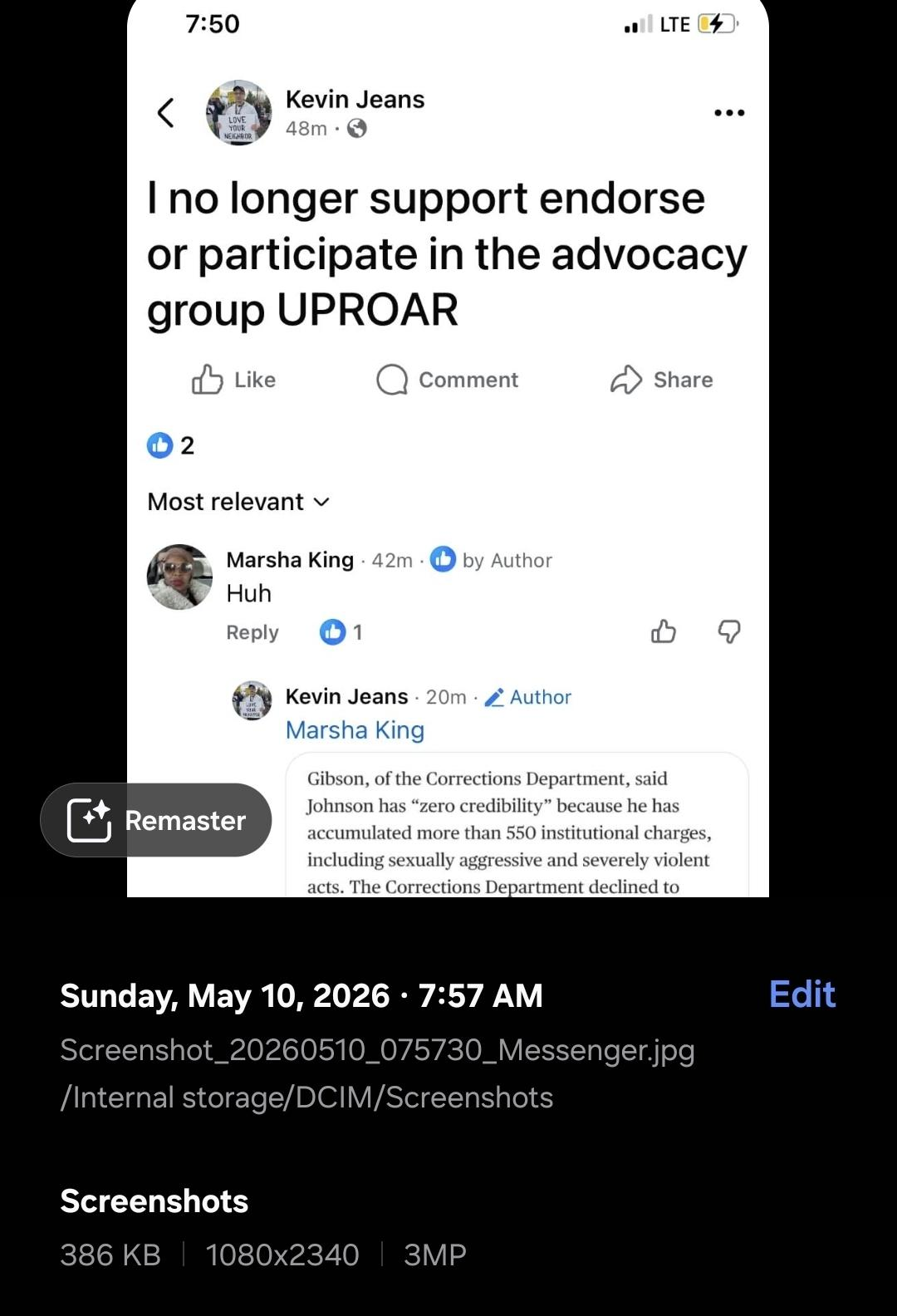
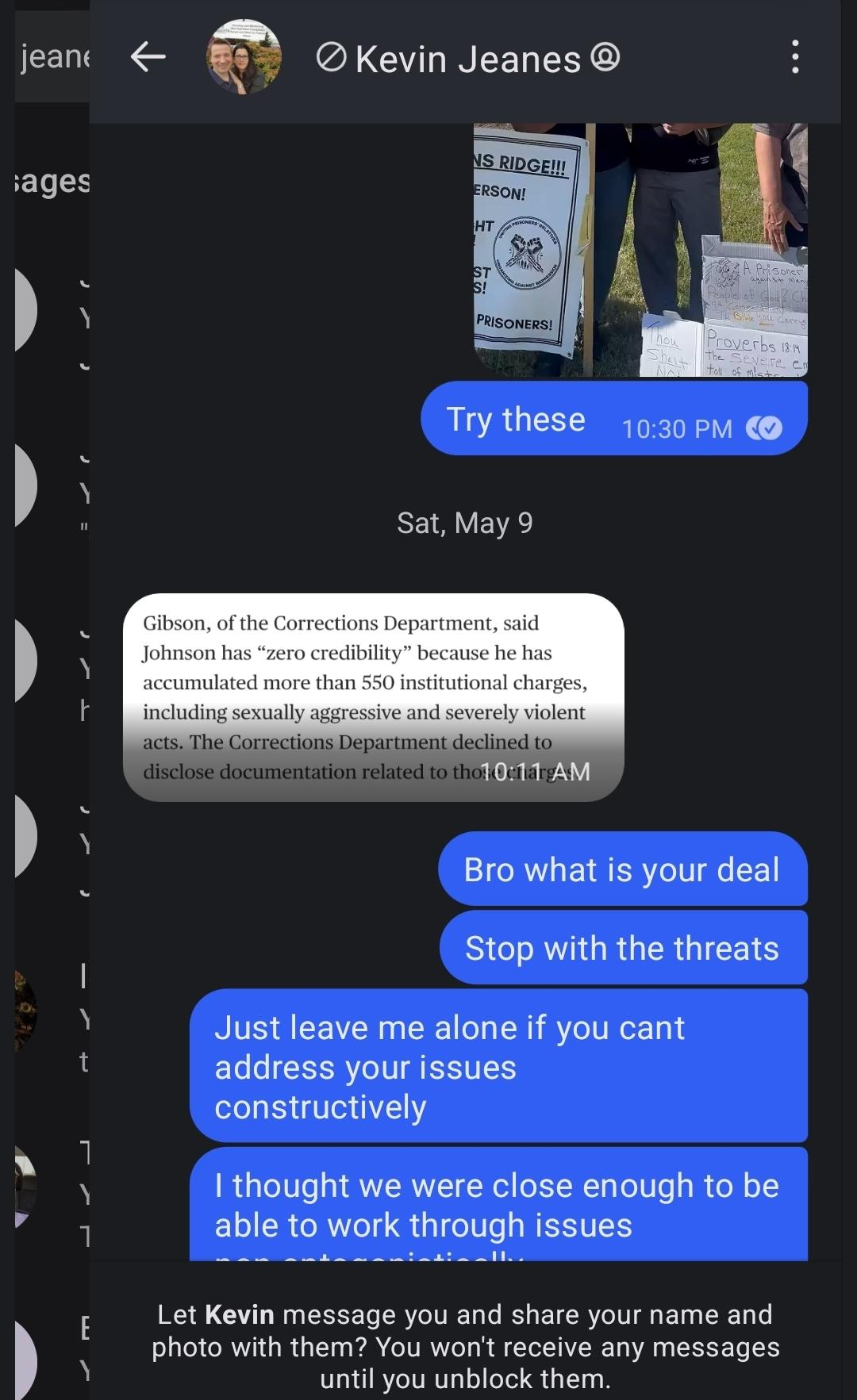
He sent the same prison-generated quote directly to Evi, despite claiming he wanted no contact. Evi responded by telling him to stop with the threats and leave them alone.
He pushed his “taking credit” narrative into UPROAR listserv space through multiple sockpuppet accounts: Harriet Tubman’s Cat and Strike 13th:
“Once again taking credit for other peoples work. No one is united with UPROAR now.”
The evidence strongly indicates that Jeanes distributed the attack through a linked account system that carried different parts of the campaign: Issaquah for legal threat, Humanize Humanity for sexualized smear email, Marshawn for digital blackface social-media amplification, Strike 13th and Harriet Tubman’s Cat for listserv echo, and CCCAN as the destination for redirected infrastructure.
The “Rashid Sexual Aggression” email was not a careful concern about a specific incident. It was a sexualized character-assassination email written in Jeanes’s style. Its function was not accountability. Its function was defamation.
This is why Jeanes’s harassment/defamation accusation is an inversion. It casts him as the injured party while concealing that he was the one spreading false and misleading allegations, legal threats, listserv attacks, and sexualized smear material.
V. Jeanes and Dawn Knew the South Carolina Allegation Was Retaliation/PREA-Related
The South Carolina “exposure” allegation Jeanes later used as smear material did not arise in a neutral context. It arose after Rashid published about SCDC abuse and after outside calls and complaints began.
Rashid’s pending civil rights complaint alleges that after he was released from RHU to general population, he sent out an article on May 14, 2025 titled “Virginia Breaks a Leg to Transfer me to South Carolina.” The complaint says the article criticized VDOC, SCDC, Davis, and Earley, was widely circulated, generated public complaints to VDOC and SCDC headquarters offices, and was met with immediate retaliation.
The complaint further alleges that SCDC Inspector General agent Fergoli came to Rashid’s RHU cell and threatened him over outside pressure. According to the complaint, Fergoli told Rashid that his people and the media needed to stop calling and emailing headquarters about him and SCDC, that Rashid needed to stop writing articles about SCDC, and that otherwise he would stay in RHU, “get hurt,” face criminal prosecution, and have all outside communication cut off.
The complaint also alleges that the “exposure” allegation was fabricated as a pretext. Rashid alleges that Blakeley loudly told the cellblock that Rashid had exposed himself to Sgt. Byrd, that this was false and slanderous, and that officials expected Rashid would be reluctant to publicize it because of embarrassment. The complaint alleges that Rashid repeatedly requested review and preservation of surveillance footage that would disprove Byrd’s account, but officials refused to review or present it.
The complaint is especially important because it describes the sexualized allegation as part of the same communications-suppression machinery. Rashid alleges that the allegation was fabricated because officials expected he would be reluctant to publicize it out of embarrassment; that surveillance footage would disprove the allegation; that officials refused to review or present that footage; and that the guilty finding was used to impose RHU time and stack phone, visitation, and canteen restrictions. This is precisely the mechanism Jeanes later exploited: take a prison allegation designed to shame and silence Rashid, treat the prison’s version as authoritative, and use it to make people less willing to defend him.
That litigation record supports the same context that UPROAR circulated in May 2025.

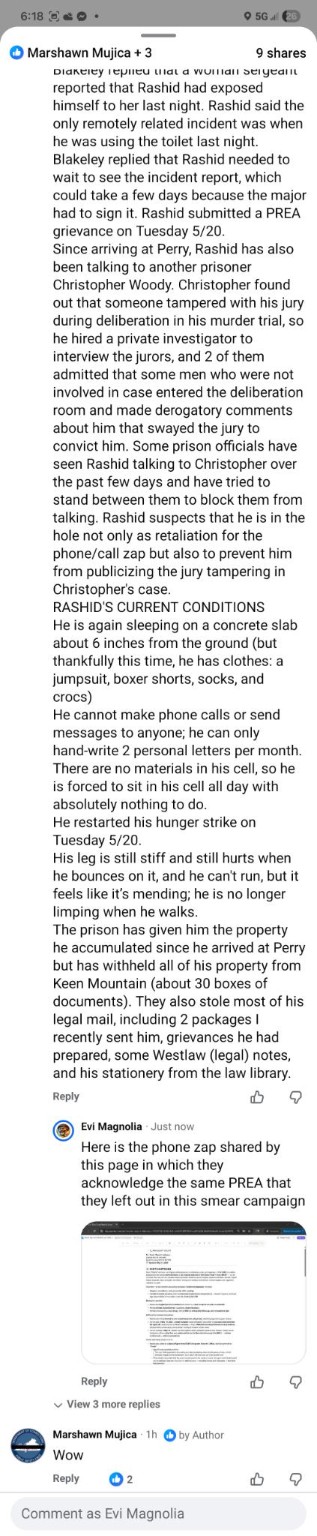
The May 2025 UPROAR update explained that Rashid had been using the toilet when a woman sergeant looked into his cell window and remained there after he told her he was using the toilet. It framed the incident as a PREA concern involving cross-gender viewing of a prisoner’s private body parts while using the toilet. It then described Rashid being placed in RHU, an Inspector General threat over outside calls and complaints, tablet/phone/message cutoff, Rashid’s PREA grievance, and Rashid’s request that supporters intensify pressure rather than back down. The update also stated that Rashid wanted Jeanes updated.

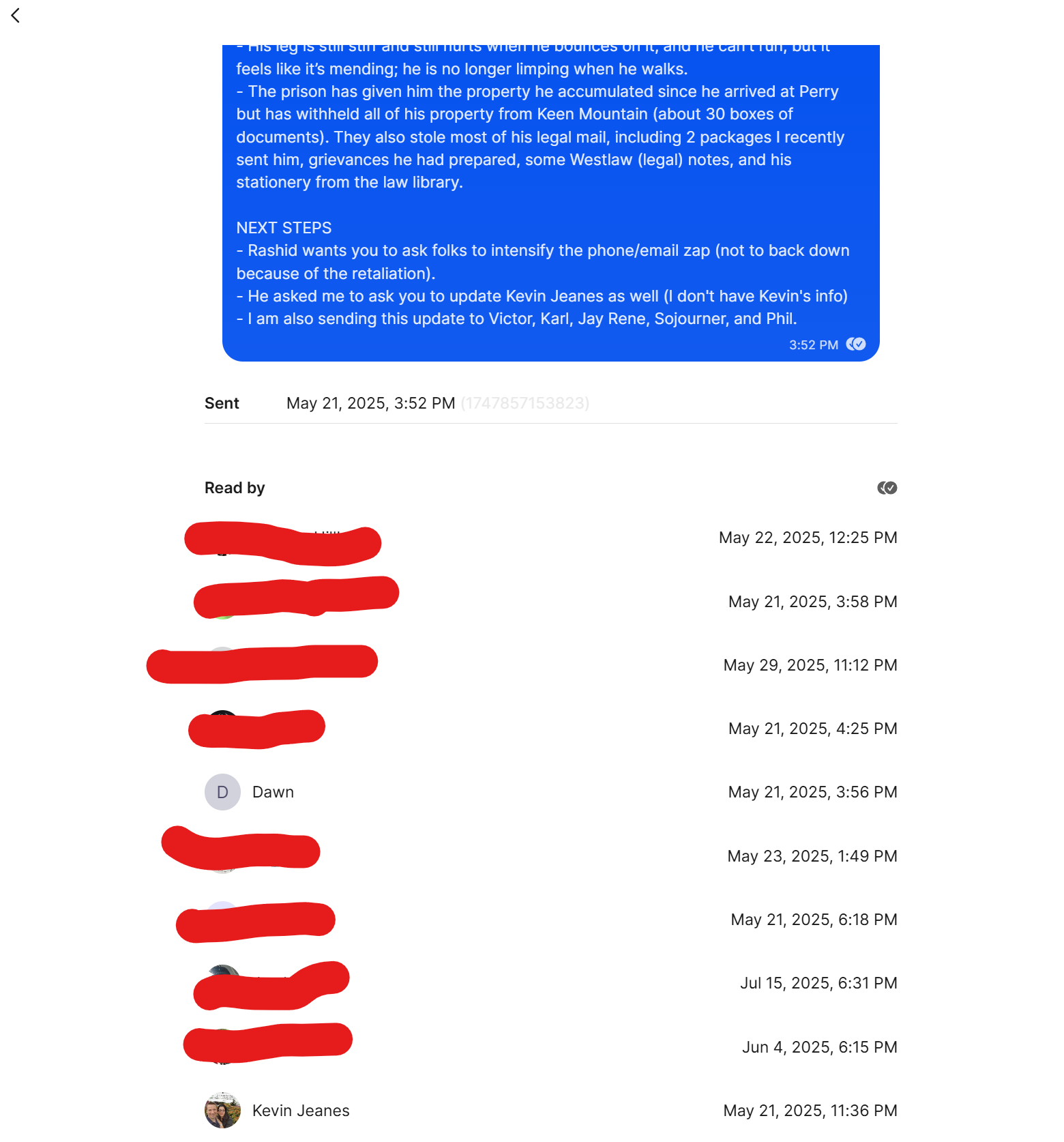
This is crucial. Jeanes did not later misunderstand an isolated disciplinary charge. He reversed the meaning of an anti-retaliation update he had already read.
The original frame was:
SCDC is using a sexualized allegation to justify RHU and communication cutoff.
Rashid has filed a PREA grievance.
Supporters should intensify pressure.
Jeanes should be updated.
Jeanes’s May 2026 frame became:
Rashid is dishonest and discredited.
UPROAR is toxic for defending him.
People should distance themselves from Evi and UPROAR.
That was not good-faith concern. It was deliberate context-stripping.
Rashid’s own published articles confirm the retaliation pattern
Rashid’s May 15, 2025 article, “Virginia Breaks a Leg to Transfer Me Out of State,” is important because it is the article the later retaliation narrative centers on. In it, Rashid described the South Carolina transfer, alleged injury in transport, placement in solitary, and blocked attorney access. He wrote that it was clear he was “facing retaliation” for challenging and exposing prison abuses. That article is the public criticism after which SCDC allegedly moved against him.
Rashid later summarized the same sequence in “Poisoning My Pen.” He wrote that his May 15 article generated public protest and media inquiries, and that five days later he was thrown into solitary and threatened by SCDC Inspector General agent Jamie Fergeli. Rashid wrote that the threat was that if he continued writing and did not tell supporters and media to stop contacting SCDC, he would remain in solitary, “get hurt,” and have his communication lines cut off.
The pending civil rights complaint gives this same narrative in sworn litigation form. Rashid alleges that Warden Earley described RHU confinement as a “forewarning” of what Rashid would face if he continued media exposure, critical journalism, litigation, and public attention campaigns. The complaint also alleges that after Rashid’s May 14 article generated public complaints, Fergoli threatened him over outside calls and articles, officials fabricated the Byrd exposure report as a pretext, and the disciplinary punishment was designed to stack phone restrictions and keep him from communicating with the outside.
VI. Jeanes Used the Allegation the Same Way SCDC Used It
SCDC used the allegation to discredit Rashid after Rashid criticized SCDC.
Jeanes used the same allegation to discredit Rashid after Rashid criticized Jeanes.
That parallel is the core of this report.
In May 2025, SCDC used the “exposure” allegation after Rashid published about his transfer abuse and Perry conditions. The allegation helped justify RHU placement, communication cutoff, and the reversal of Rashid’s PREA complaint into a disciplinary narrative. Rashid’s complaint alleges that officials fabricated the allegation as a pretext and that the real aim was to keep him from communicating with the outside.
In May 2026, Jeanes used the same allegation after Rashid criticized him, Benjamin Crump’s role, and media strategy in the Aubrey McKay case. Jeanes stripped away the retaliation/PREA context and repackaged the allegation as proof that Rashid was sexually predatory, dishonest, and discredited.
In both cases, Rashid’s political speech was displaced by a sexualized danger narrative. His criticism was not answered. It was pathologized.
SCDC used that logic to justify isolation and communication suppression. Jeanes used it to defend his reputation, poison a loved-ones support space, and sabotage UPROAR.
A genuine concern about misconduct would have looked different. Jeanes could have asked for clarification. He could have used UPROAR’s conflict-resolution process. He could have reviewed the May 2025 context he had already received. He could have treated a prison disciplinary allegation as a disputed prison allegation rather than as fact. He could have protected the privacy of everyone involved while seeking a serious process.
He did none of that.
He used the old allegation as a “new” weapon, feigning ignorance of the retaliatory and suppressive origins of the SCDC charge.
Jeanes did not merely repeat a prison allegation; he weaponized the very retaliation narrative Rashid was already suing SCDC and VDOC over, using it to discredit Rashid after Rashid criticized him.
VII. The Method: Ignore, Isolate, Discredit, Kill
Rashid had already named the official method before Jeanes enacted it from outside the prison walls. In his January 2025 article, “Ignore, Isolate, Discredit, Kill: The Official Response to Critical Exposure,” Rashid argued that prison officials respond to effective exposure in a predictable sequence: first they ignore the critic; if that fails, they isolate him; then they attack his character to discredit him; and when those methods fail, they escalate toward physical destruction.
That article matters here because it directly addresses the Kyle Gibson/VADOC quote that Jeanes later circulated. Gibson claimed Rashid had “zero credibility” because of hundreds of institutional charges, including alleged “sexually aggressive and seriously violent acts.” Rashid answered that this was not evidence of dishonesty, which would be the only relevant basis for attacking a journalist’s credibility. He also emphasized that the sexualized claims were criminal imputations for which he had not been criminally charged, tried, or convicted, and that this was exactly the kind of slander prison officials use to incite hostility against prisoners they want discredited.
Rashid also situated that tactic historically. He connected the use of sexual stigma against Black men to the old Jim Crow practice of portraying Black men as sexually deviant or predatory in order to discredit them, incite hostility, and justify violence. In other words, the Gibson quote was not merely a bad-faith media statement. It was part of a racialized carceral method: attack the credibility of a Black prison journalist by turning him into a sexual danger.
This is why Jeanes’s use of the Gibson quote is so important. Jeanes did not merely repeat one official talking point. He circulated the very discrediting method Rashid had already identified as part of the prison system’s response to critical exposure. VADOC used the Gibson quote to discredit Rashid after he exposed Red Onion abuses and self-immolations. SCDC used solitary, communication cutoff, and sexualized allegations after Rashid exposed South Carolina abuses. Jeanes then used the same allegations and the same framing after Rashid criticized him.
That is the political core of the convergence. Jeanes’s outside campaign did not need to be formally coordinated with SCDC or VADOC to serve the same function. It accepted the prison system’s claims as authoritative, stripped away the retaliation context, and used those claims to suppress the speech of the prisoner who had exposed them.
This is what it means to operate like the prison officials Rashid was exposing. The method is not only physical custody. It is also credibility warfare. Officials isolate the prisoner materially; then they discredit him socially so people will not defend him. Jeanes’s campaign worked on that second front. While SCDC isolated Rashid inside Perry, Jeanes worked outside to make Rashid appear unworthy of defense.
The result was a division of labor that served the same political end: isolate Rashid, discredit him, fracture support, and make his published criticism easier to punish.
VIII. Jeanes Lied to Aubrey McKay’s Family-Support Space
Jeanes’s conduct in the Justice for Aubrey chat was not simply emotional venting. He lied to and misled a grieving family-support space.
He told that space Rashid had a “new” South Carolina charge, even though the allegation was from May 2025 and Jeanes had already read the UPROAR update explaining it as disputed, retaliatory, PREA-related, and tied to SCDC retaliation for Rashid’s May 15 article.
He told that space UPROAR was taking credit for Aubrey McKay’s public attention, even though the conflict began because Rashid criticized media/legal strategy around Aubrey’s case and Benjamin Crump’s role in it.
Jeanes’s “taking credit” claim is directly contradicted by the actual language of Rashid’s Crump/Aubrey article. Rashid did not say that only he or only UPROAR brought attention to Aubrey’s case. He wrote: “The case gained public attention ONLY because individual advocates and groups like UPROAR persisted in publicly protesting his case.” That sentence explicitly credits people beyond Rashid and beyond UPROAR. Jeanes’s claim that Rashid and UPROAR were erasing others’ work was therefore false.
Jeanes portrayed remaining UPROAR members as toxic, claimed Evi was trafficking Rashid’s nonsense, and suggested people block Evi.
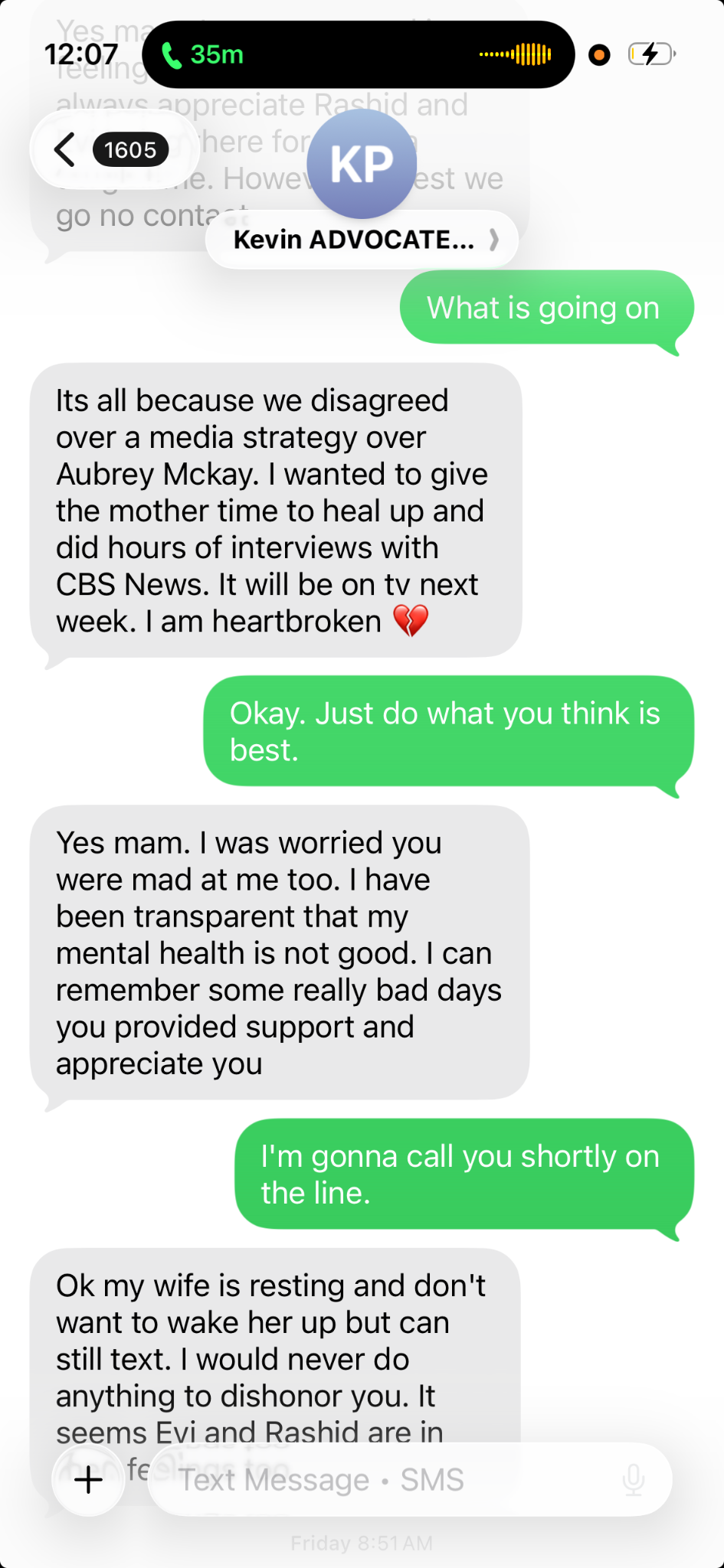
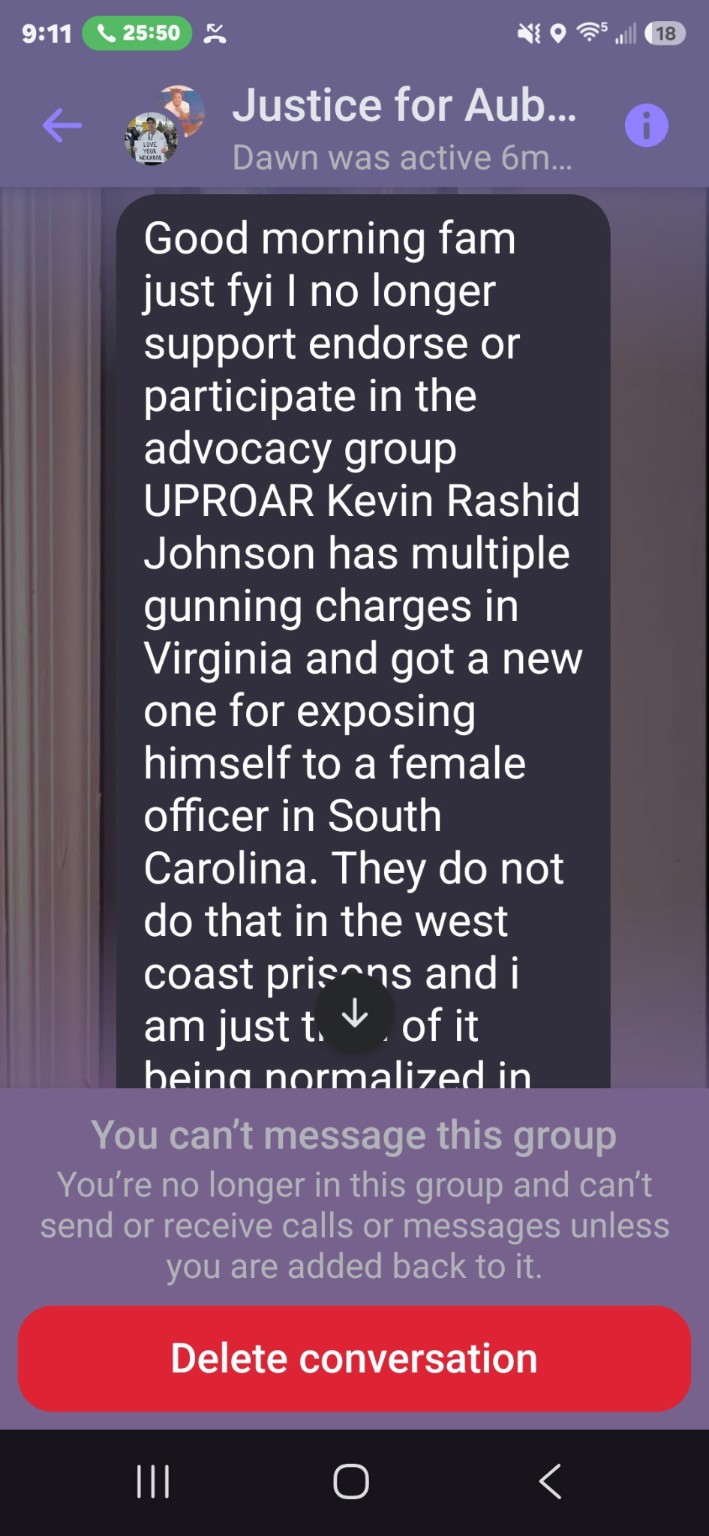
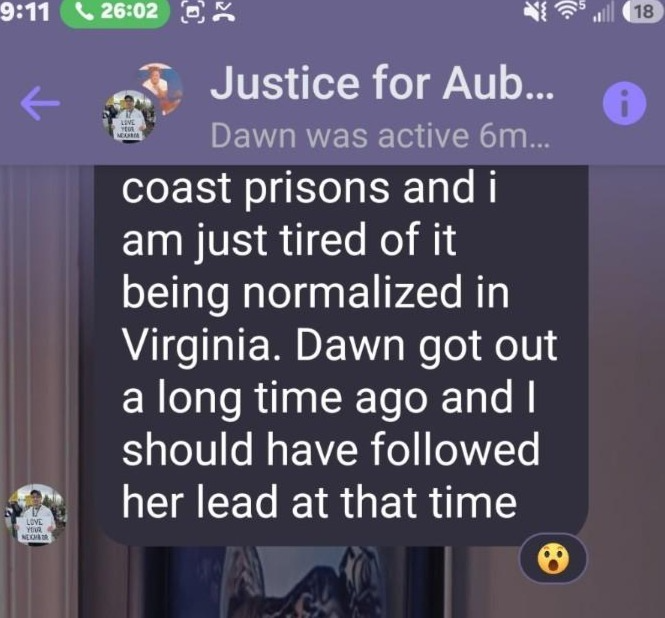
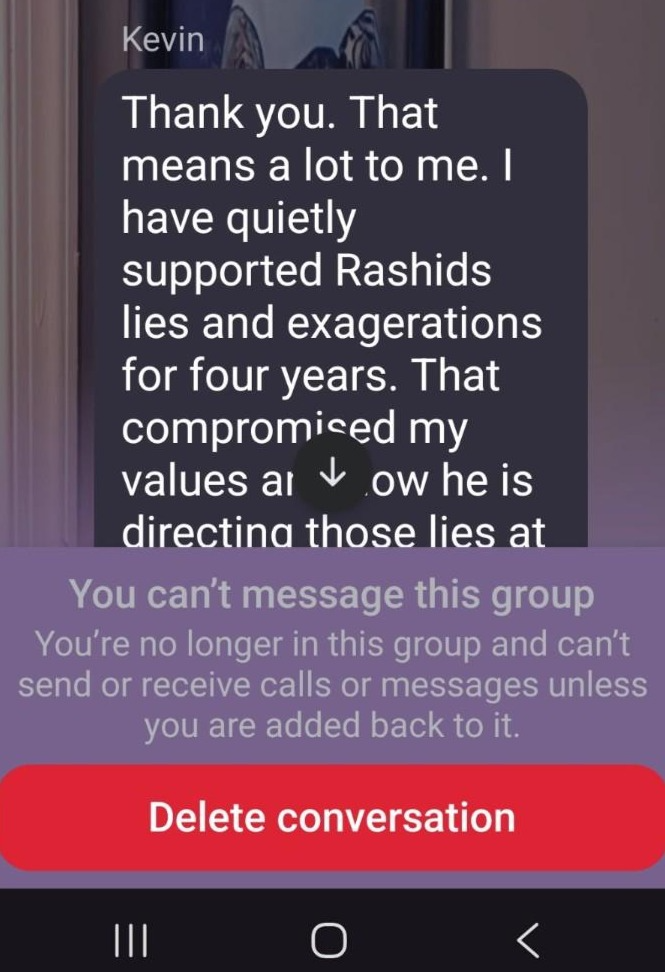
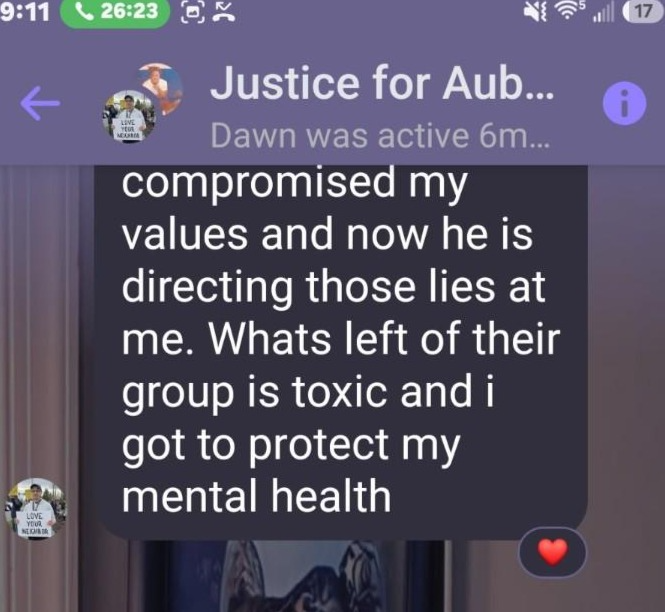
The record does not show that Aubrey’s family acted on Jeanes’s suggestion to block Evi. The harm lies in the attempt. Jeanes used a grieving family-support space as terrain for reputation defense, slander, and sabotage.
Jeanes’s own message to Melinda makes this worse. He acknowledged that the dispute was “all because” of disagreement over Aubrey McKay media strategy. He said he wanted to give Aubrey’s mother time to heal and told Melinda he would never do anything to dishonor her.
He then did exactly what that promise should have ruled out. He brought his dispute with Rashid and UPROAR into the Justice for Aubrey space, lied about Rashid’s South Carolina allegation, portrayed UPROAR as toxic, suggested Evi be blocked, and falsely framed UPROAR as taking credit for Aubrey’s public attention.
That was a betrayal of the loved ones whose trust he claimed to respect.
The most revealing statement may be Jeanes’s claim that he had “quietly supported Rashid’s lies and exaggerations for four years.” That statement creates a dilemma. If true, Jeanes admits he knowingly supported what he believed were lies for years, betraying prisoners, families, and supporters. If false, he was slandering Rashid in a grieving family-support space to protect his own reputation. Either way, it shows that Jeanes was not acting as an accountable comrade.
IX. Jeanes Violated UPROAR’s Code of Conduct and Confidentiality Policy
UPROAR had a Code of Conduct and Confidentiality Policy in place before Jeanes left. The Code required respectful communication, direct discussion where possible, confidentiality, accountability, avoidance of gossip and rumor-spreading, giving credit for others’ work, and good-faith participation. It also provided a conflict-resolution process.
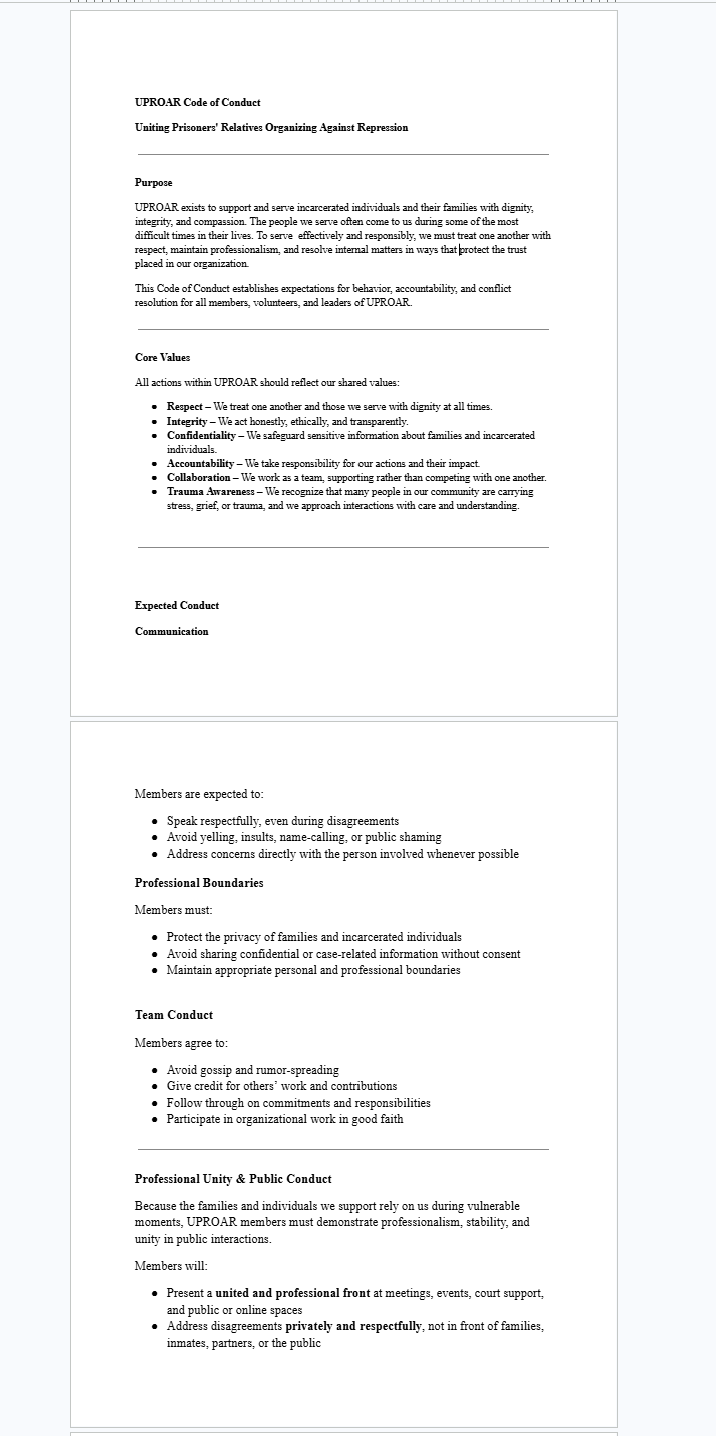
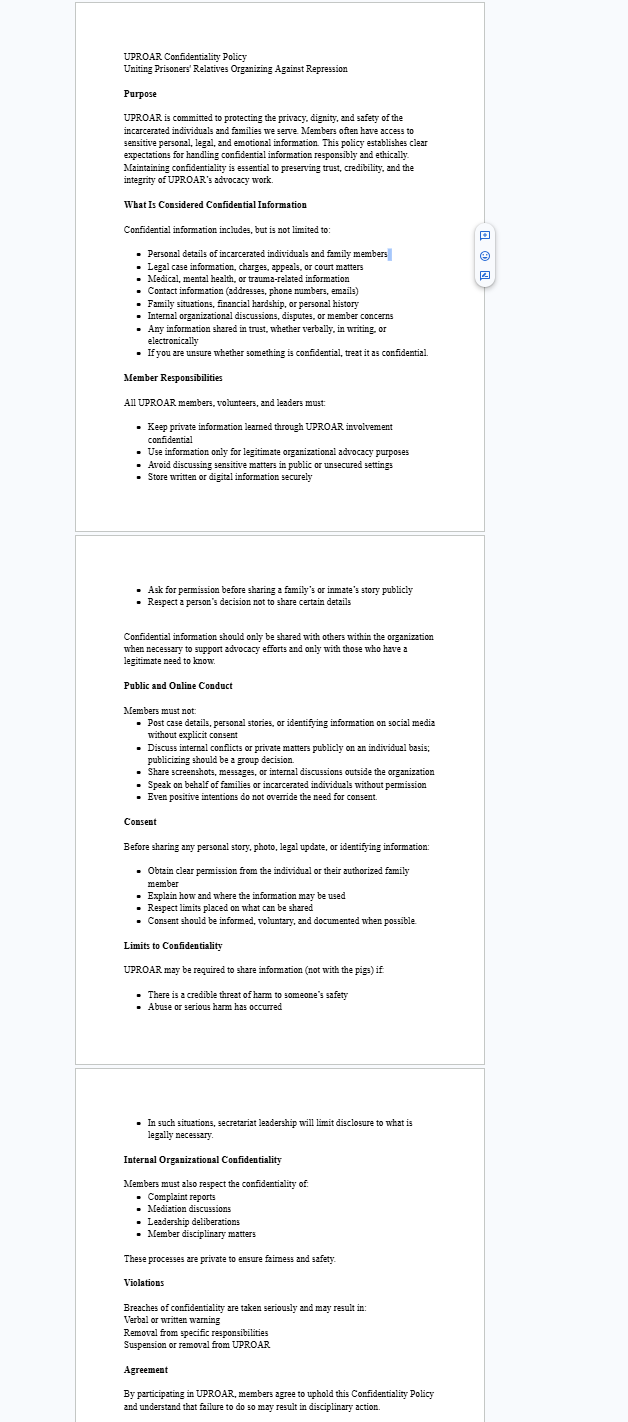
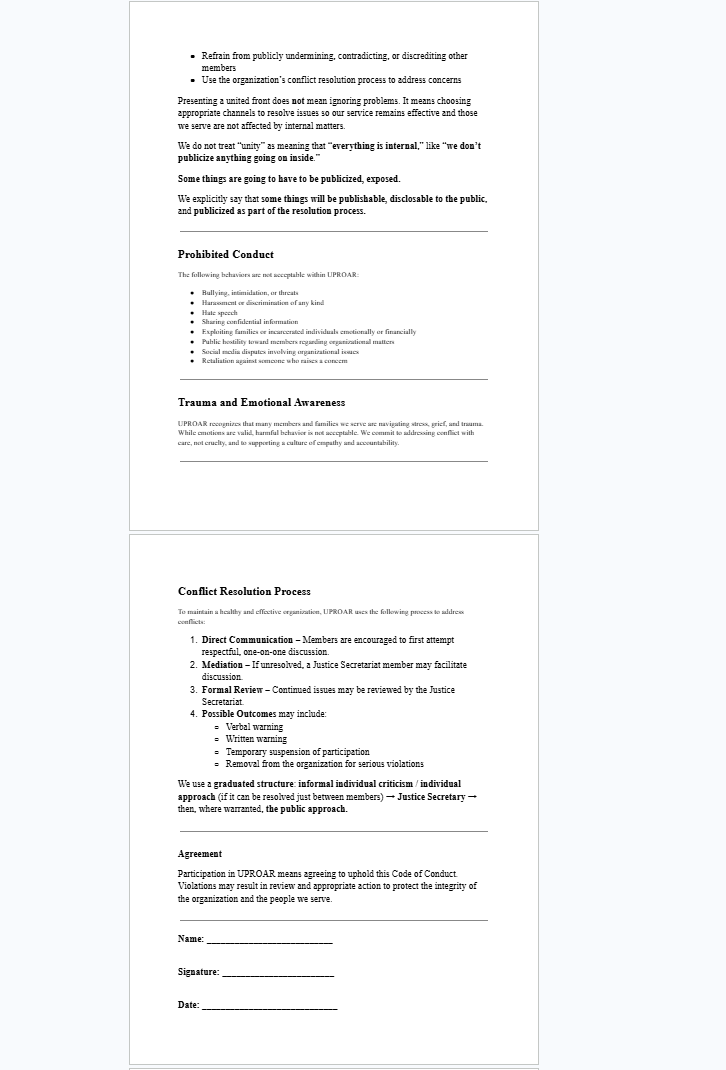
UPROAR had not left accountability to vibes, personal loyalties, or informal reputation contests. The organization had collectively studied Constructive Criticism, and that study helped shape UPROAR’s Code of Conduct and Confidentiality Policy. That means Jeanes did not merely violate interpersonal norms. He violated a political and organizational standard UPROAR had studied, discussed, and attempted to institutionalize.
The standard was clear: criticism should be concrete, purposeful, accountable, and directed toward strengthening the people’s ability to struggle. It should clarify contradictions, correct errors, protect collective work, and distinguish comradely struggle from punishment, coercion, gossip, and reputation defense. The question was not whether criticism was allowed. Criticism was necessary. The question was what kind of criticism served prisoners and loved ones, and what kind of “criticism” became domination.
Jeanes chose the opposite method. Instead of direct criticism, he used gossip and public denunciation. Instead of verification, he amplified prison narratives. Instead of mediation or formal review, he threatened legal action. Instead of protecting collective infrastructure, he helped redirect it. Instead of strengthening the capacity of prisoners and loved ones to struggle, he made criticism feel dangerous, punitive, and factional.
That is why his conduct was politically corrosive. When someone responds to criticism with retaliation, legal threats, smear campaigns, and infrastructure attacks, they teach others that giving criticism is dangerous. They push the organization away from criticism/self-criticism and back toward avoidance, whisper networks, personal loyalty blocs, and liberal conflict management. Jeanes’s conduct did exactly that: it punished criticism, chilled accountability, and converted an internal contradiction into a factional attack.
UPROAR’s Code of Conduct did not require silence in the face of sabotage. It recognized that some matters may need to be publicized as part of resolution when private process is blocked or when the conduct itself threatens collective safety and accountability. Jeanes blocked direct process, refused good-faith correction, weaponized sensitive advocacy information, threatened legal escalation, pushed factional conflict into supporter infrastructure, and circulated state-serving narratives while Rashid was being isolated.
On UPROAR’s own standard, then, Jeanes’s conduct was not legitimate criticism. It was a rejection of the accountability process itself.
This is the class meaning of the violation. The issue is not that Jeanes had criticisms. A comrade can criticize Rashid. A comrade can criticize UPROAR. A comrade can challenge a media strategy. But a comrade uses methods that strengthen the people’s ability to struggle: direct criticism over gossip, verification over allegation-laundering, collective process over unilateral escalation, accountability over reputation defense, and unity around the oppressed over factional sabotage.
Jeanes inverted each of those principles.
He also violated the purpose of confidentiality. The May 2025 South Carolina update was circulated for anti-retaliation advocacy. It contained sensitive information about a PREA grievance, a disputed sexualized allegation, RHU placement, legal property, communications cutoff, and a pressure campaign. It was not a weapon to be stripped of context and redeployed against the prisoner it was created to defend.
Jeanes’s conduct harmed UPROAR members, not only Rashid and Evi. It exposed supporters to legal threats and factional attacks. It created confusion about whether UPROAR was dishonest, toxic, or unsafe. It attacked the trust necessary for a loved-ones organization to function.
X. Jeanes Attacked UPROAR’s Listserv and Supporter Infrastructure
The listserv evidence matters because the attack did not remain in private messages or on Jeanes’s personal page. Jeanes pushed the conflict into UPROAR’s supporter infrastructure.
The cease-and-desist was sent to UPROAR’s listservs and public-facing addresses, broadcasting legal threats into a network of people who had joined UPROAR to support prisoners and loved ones. That transformed a supporter communication space into a site of intimidation.
Harriet Tubman’s Cat and Strike 13th echoed Jeanes’s “taking credit” accusation through UPROAR list channels:
“Once again taking credit for other peoples work. No one is united with UPROAR now.”
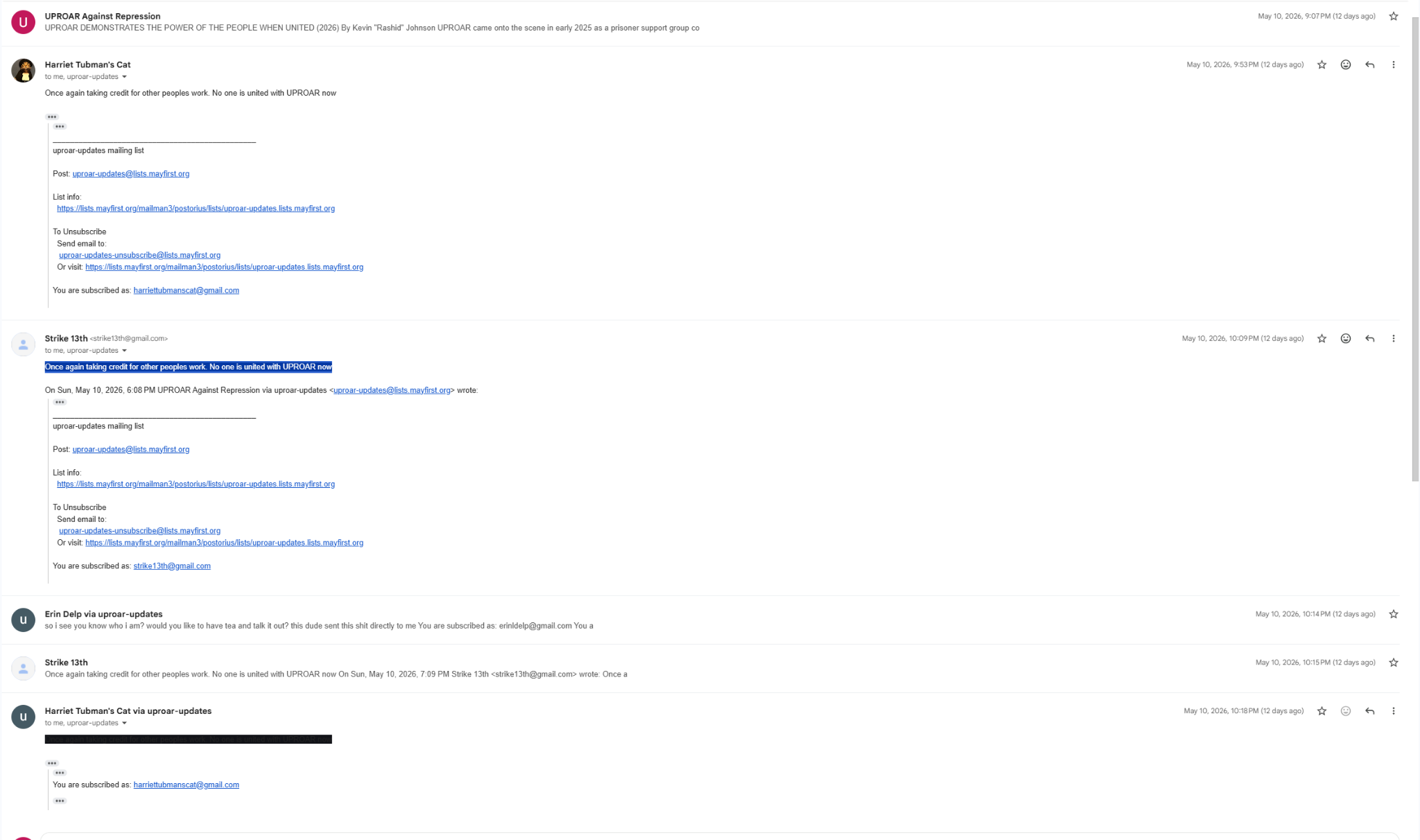
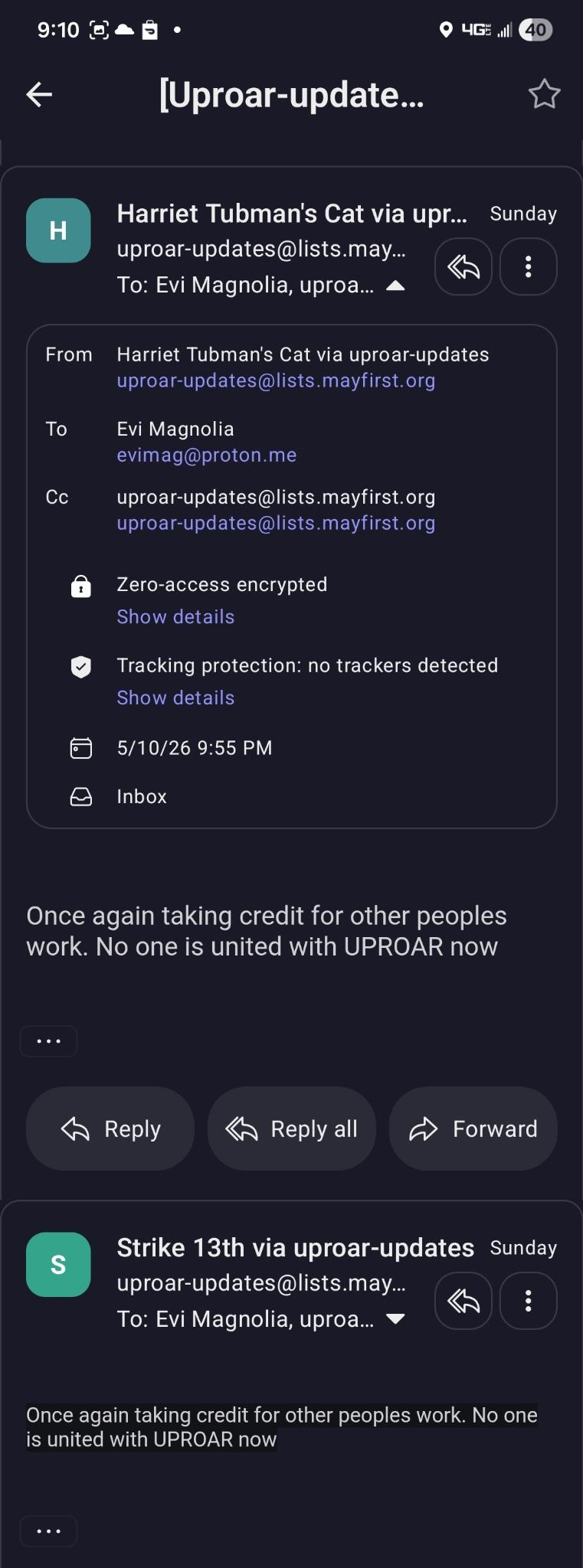
This was supporter-infrastructure sabotage. Channels built for prisoner-defense work were used to intimidate, smear, and fracture UPROAR’s base.
That matters because UPROAR’s listserv space was not Jeanes’s personal argument space. It was organizing infrastructure. People had signed up to receive calls to action, campaign updates, prisoner-defense materials, and ways to support incarcerated people and loved ones. Jeanes’s legal threats and the “taking credit” smear contaminated that infrastructure and made his personal grievance look like broader movement rejection of UPROAR.
This was meant to harm UPROAR as an organization. It harmed members and supporters who had to navigate legal threats, factional smears, and confusion instead of being able to focus on prison repression.
XI. Evidence Indicates Jeanes Used Sockpuppet Accounts and Linked Account Identities to Distribute the Attack
Jeanes did not act only through his own name. The evidence strongly indicates that he used a connected account system made up of sockpuppet accounts, linked identities, and redirected organizational infrastructure. These accounts are connected by older personal-network overlap, email-chain co-presence, campaign infrastructure, timing, repeated language, shared targets, and tactical function.
The Marshawn evidence is especially important because it does not rest on one screenshot. It shows a progression: Marshawn appears in Jeanes’s older Washington-area church/recovery world; Marshawn later appears in Jeanes’s 2026 advocacy email system; Marshawn is directly copied on a Jeanes-signed Issaquah email; Marshawn is tied to petition infrastructure that overlaps with the Strike 13th / Harriet Tubman’s Cat listserv echo; and Marshawn appears around the May 12 Rashid smear environment.
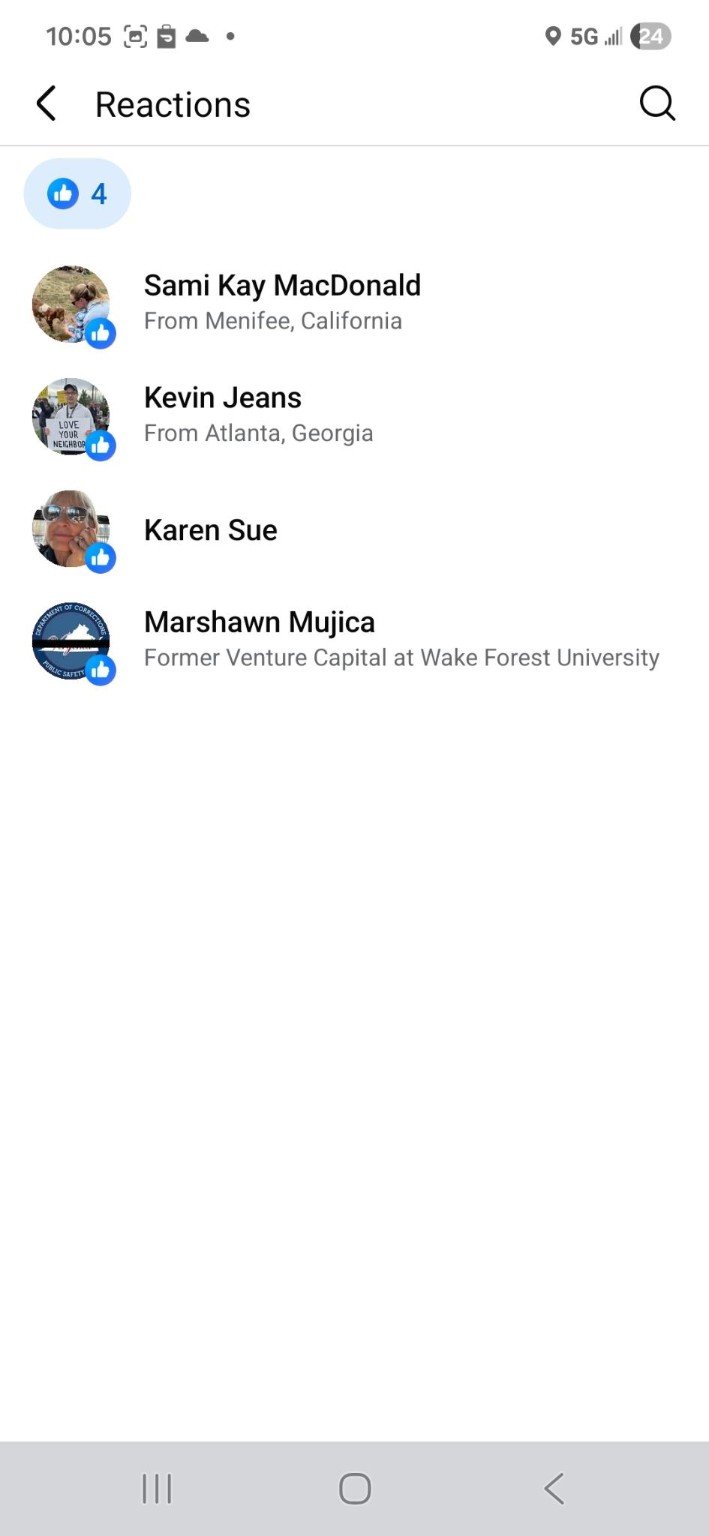
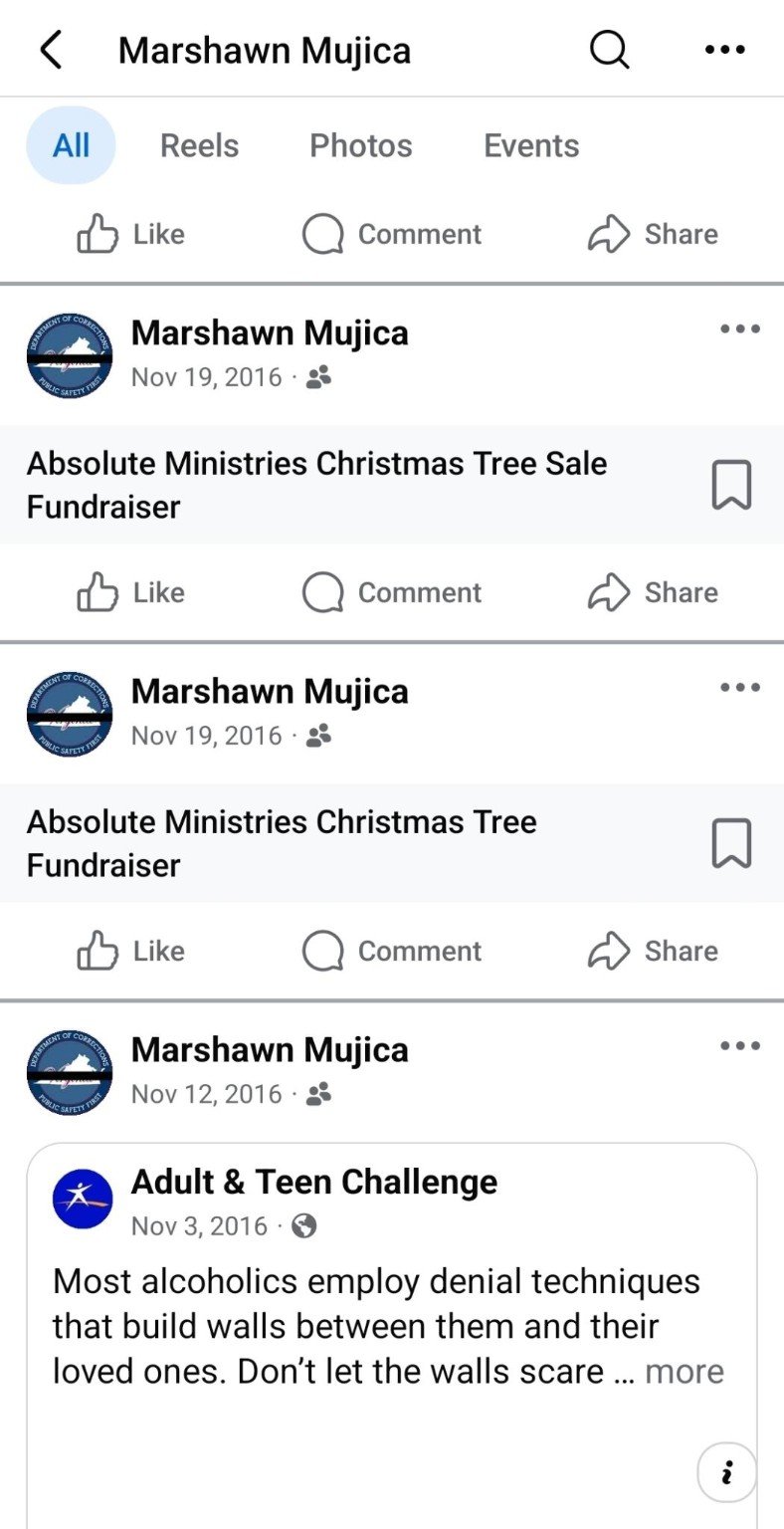

The older-network evidence is not the whole argument, but it matters. Marshawn did not appear out of nowhere in May 2026. The account tracks the same small Washington-area recovery/church environment that Jeanes occupied years earlier.
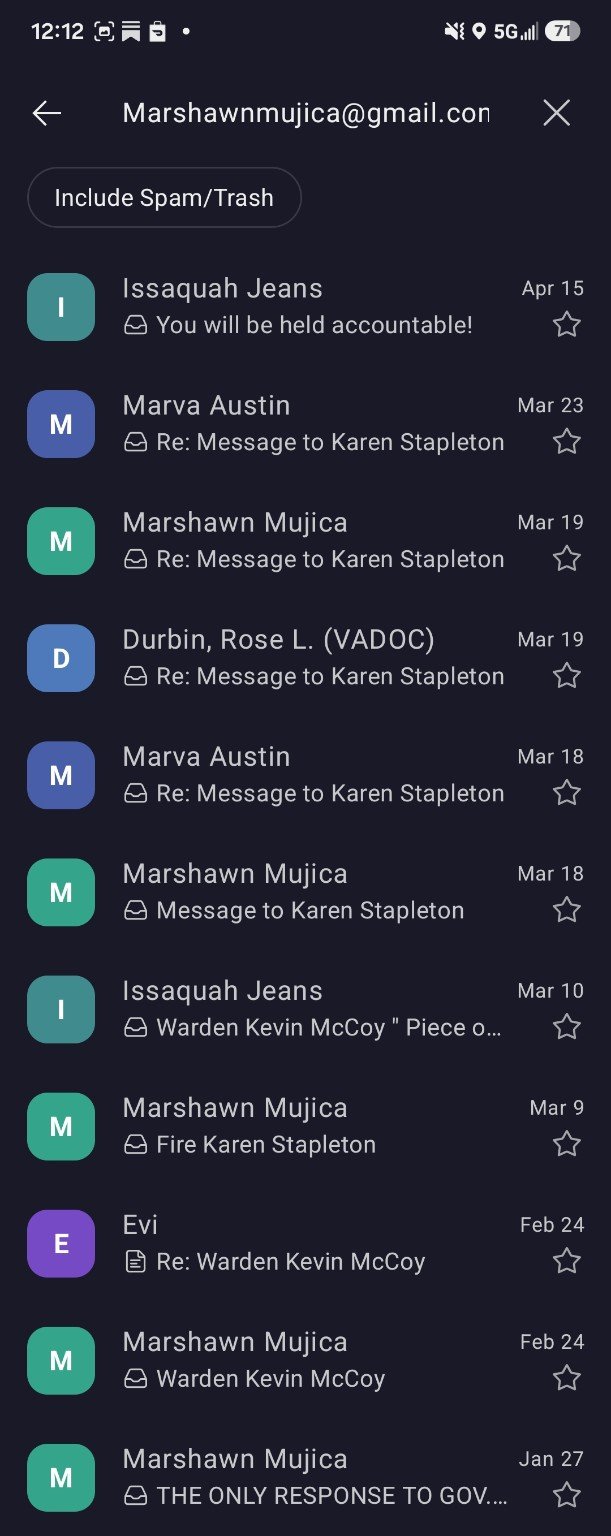
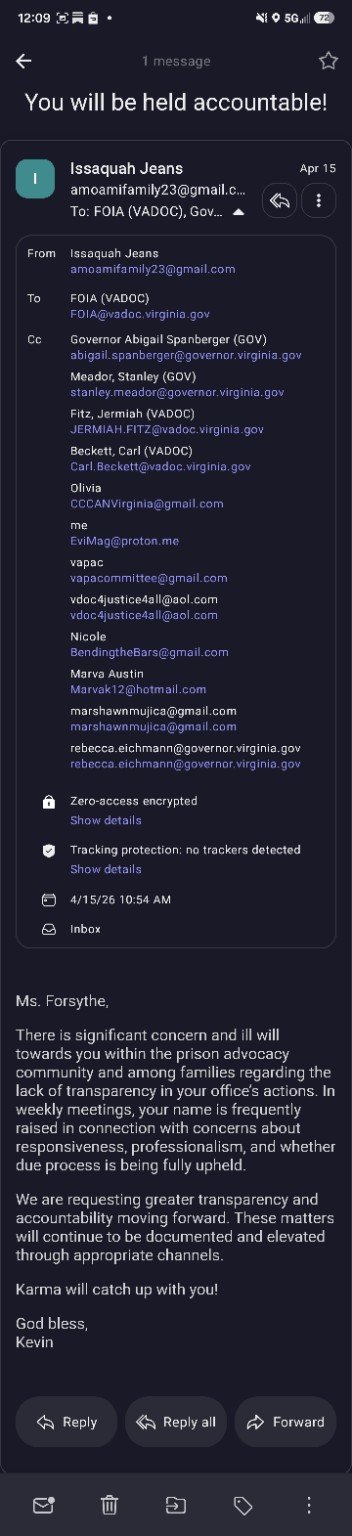
amoamifamily23@gmail.com, signed “Kevin,” copies marshawnmujica@gmail.com.
That creates a direct operational link:
amoamifamily23@gmail.com↔
Marshawn Mujica /
marshawnmujica@gmail.com
That link is more important than ordinary social-media overlap. Jeanes later used the same Issaquah identity to send the cease-and-desist signed Kevin Jeanes. In other words, Marshawn’s Gmail account sits inside the same operational email infrastructure Jeanes used for legal threats and campaign escalation.
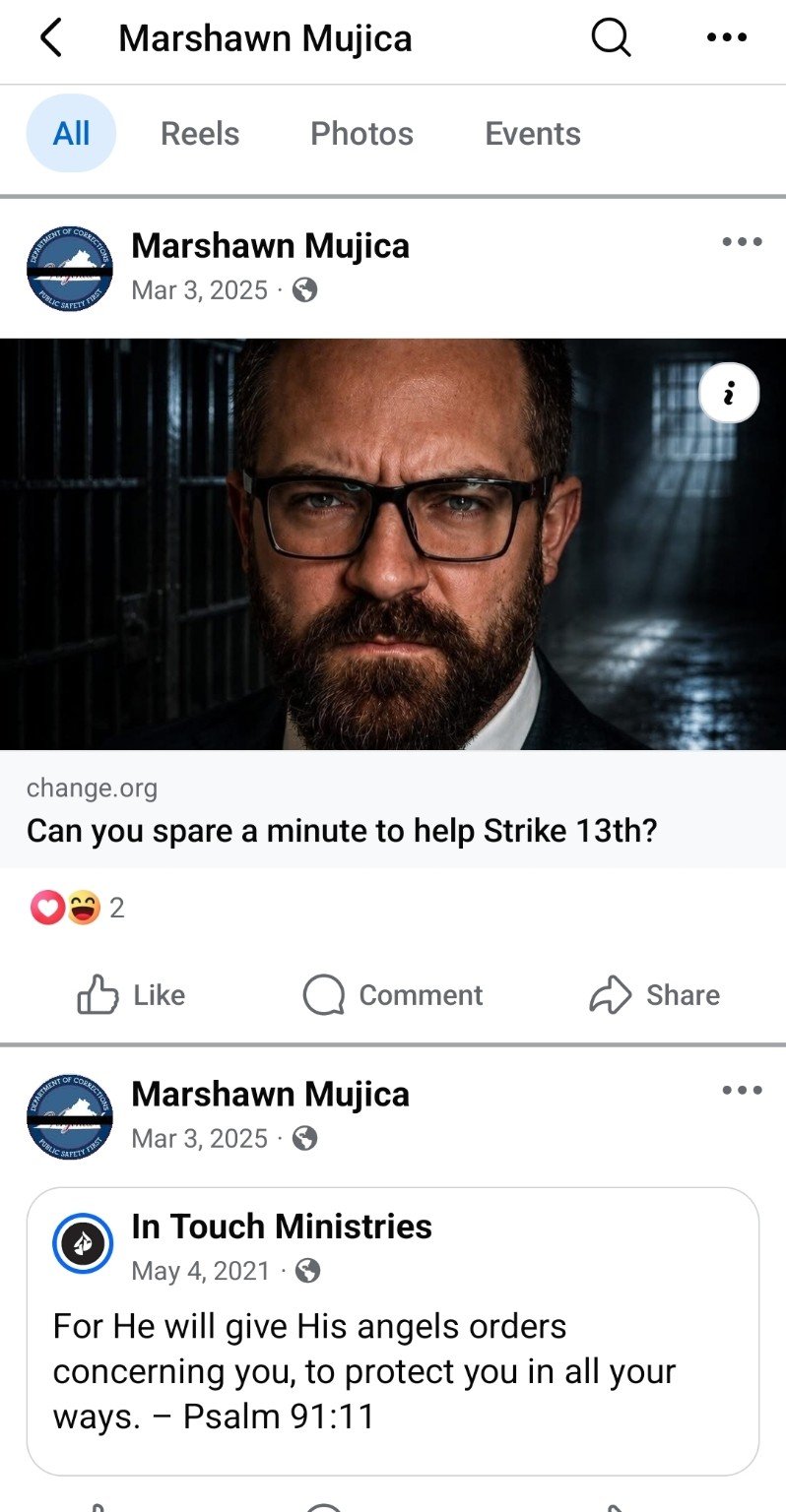
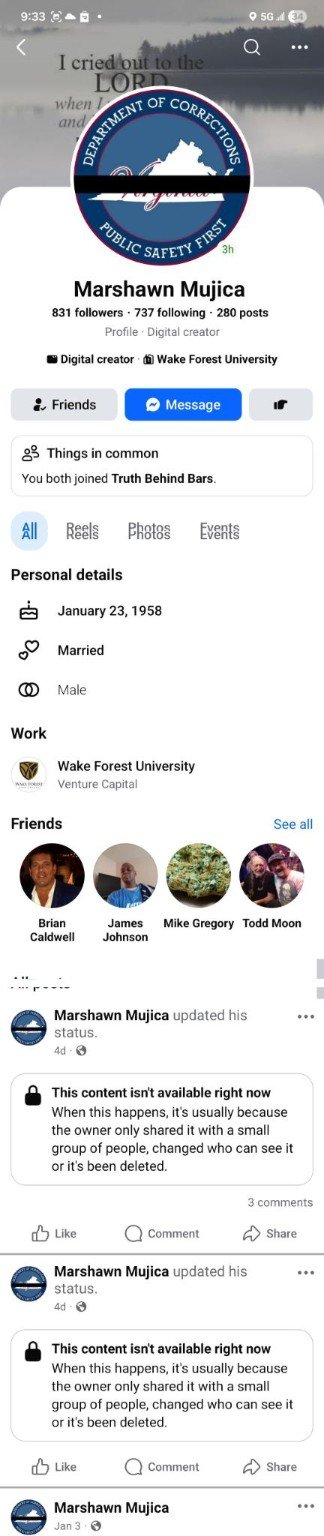
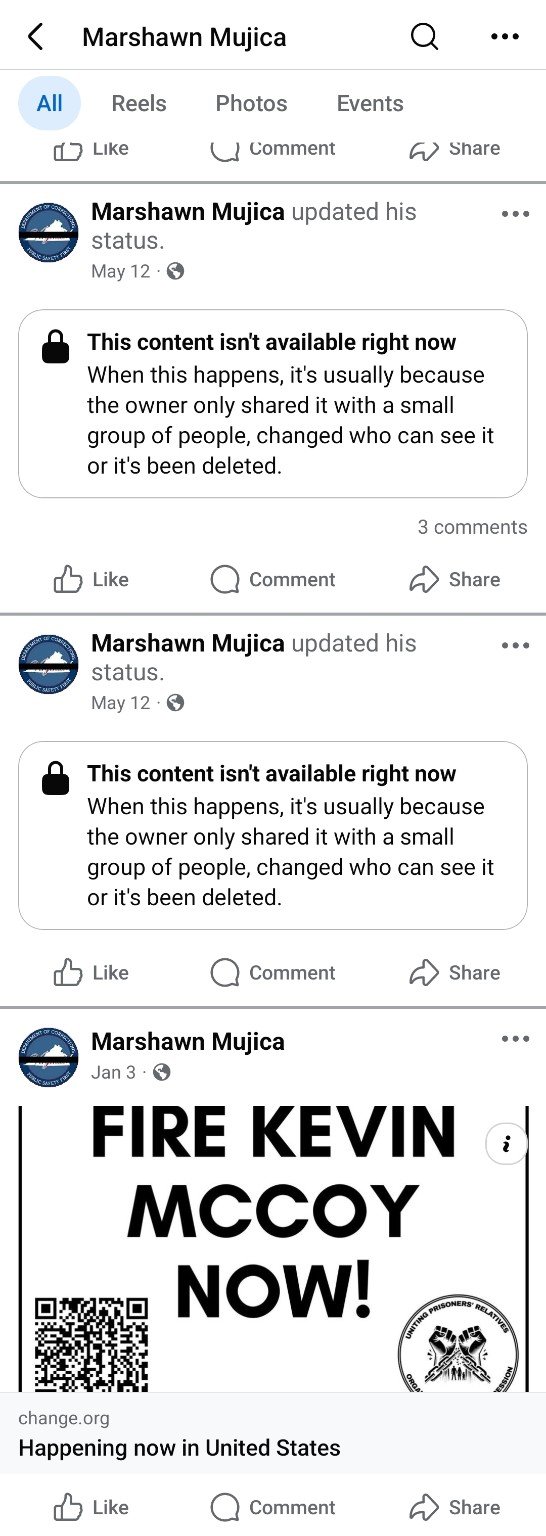
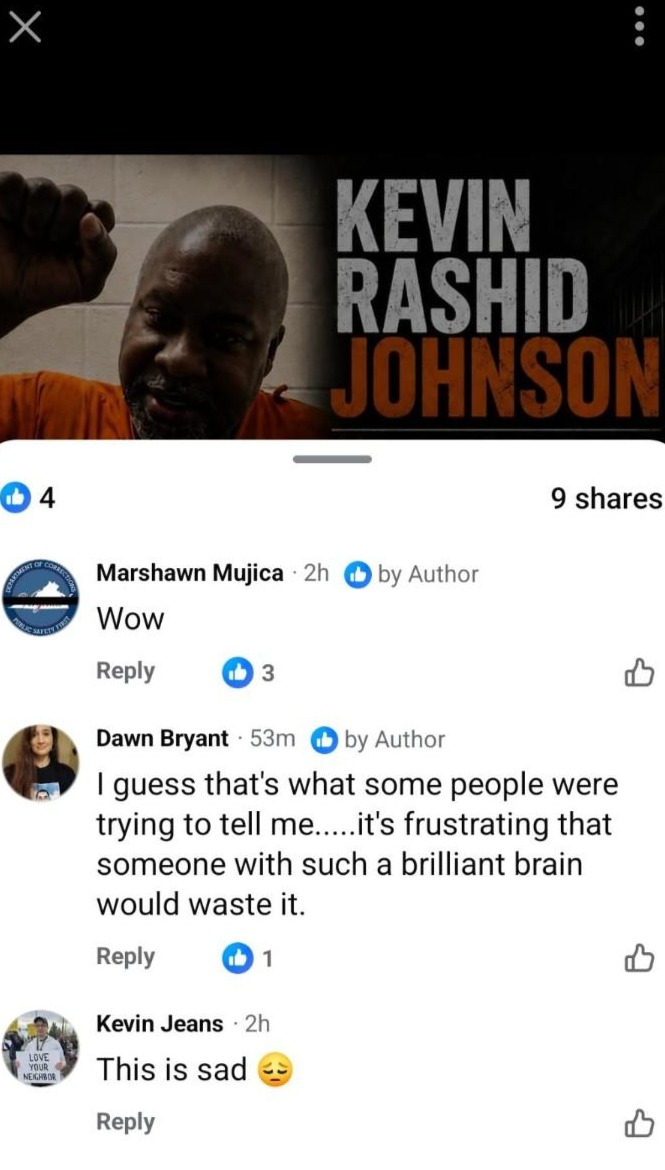
The available record therefore supports identifying Marshawn as a Jeanes-controlled or Jeanes-operated persona, not merely as a supporter who happened to agree with him. Marshawn appears in Jeanes’s old social world, in Jeanes’s operational email system, in petition infrastructure, and in the May 12 smear environment.
The political function matters. Marshawn made Jeanes’s attack appear broader, less self-serving, and less white-driven. In the context of a smear portraying Rashid, a Black incarcerated journalist, as sexually deviant and dangerous, that is digital blackface: a racialized sockpuppet persona used to manufacture social proof for a racist carceral attack.
His named account seeded the grievance and prison-generated credibility attack. Issaquah carried the legal threat. Humanize Humanity carried the sexualized email smear. Virginia Department of Corruption carried the graphic smear through Dawn’s page. Marshawn carried digital blackface social-media amplification. Strike 13th and Harriet Tubman’s Cat carried the listserv echo. CCCAN became the destination for redirected infrastructure.
| Account / Front | Function in the attack |
|---|---|
| Jeanes named account | Moral grievance, anti-UPROAR denunciation, “new charge” claim, Gibson/VADOC quote, “taking credit” narrative. |
Issaquah Jeans / amoamifamily23@gmail.com |
Jeanes-linked operational identity; cease-and-desist / legal-threat delivery. |
| Jeanes Yahoo account | Named Jeanes account in linked email chains. |
| Humanize Humanity / Close the Confederate Prisons | Evidence suggests this was another sockpuppet account in the same Jeanes-linked account system. It carried the direct email smear: “Not like us,” “Rashid Sexual Aggression,” and Orlando Trent bait emails. |
| Virginia Department of Corruption | Visual smear channel run by Dawn, amplifying Jeanes’s smear line. |
| Marshawn Mujica | Evidence strongly indicates this was a Jeanes-controlled or Jeanes-operated digital blackface sockpuppet used to make the attack appear broader, less self-serving, and less white-driven while amplifying the May 12 Rashid smear. |
| Strike 13th | Listserv echo account; repeats “taking credit” attack. |
| Harriet Tubman’s Cat | Listserv echo account; repeats “taking credit”; petition infrastructure / Issaquah-linked context. |
| Church of the Invisible People | Older email-chain node linked with Humanize, Issaquah, Strike, Harriet, and CCCAN. |
| CCCANVirginia | Older linked email participant; later destination for renamed UPROAR Facebook infrastructure. |
The evidence strongly suggests that Humanize Humanity / Close the Confederate Prisons was another sockpuppet account in the same Jeanes-linked account system. It did not appear from nowhere on May 12. It appears in older email-chain ecosystems with Issaquah, Harriet, Strike 13th, Church of the Invisible People, CCCANVirginia, UPROAR, Evi, and state/media targets. Then, on May 12, it became the channel for the most explicit sexualized smear emails.
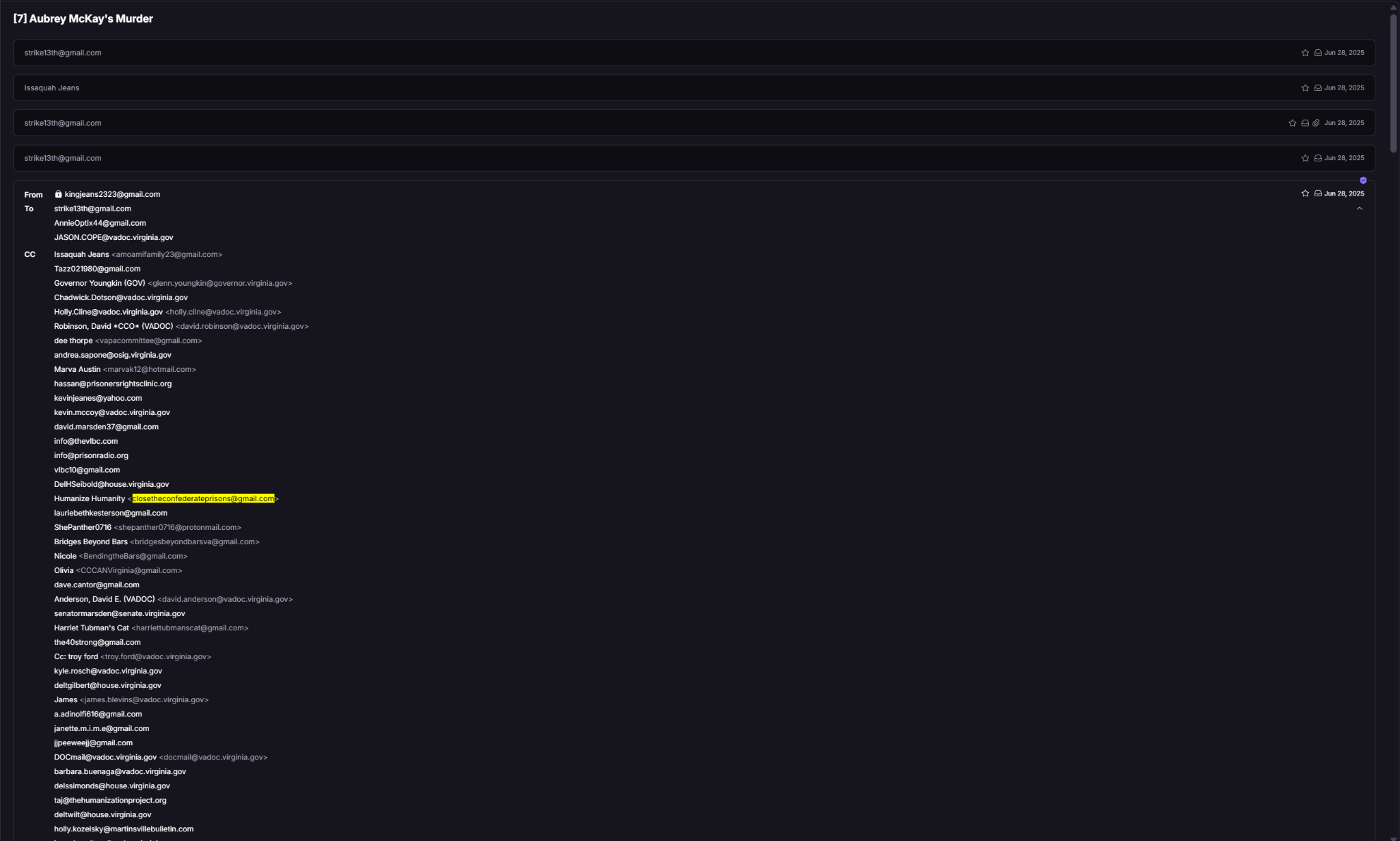

On May 12, Humanize sent the “Not like us,” “Rashid Sexual Aggression,” and Orlando Trent bait emails.
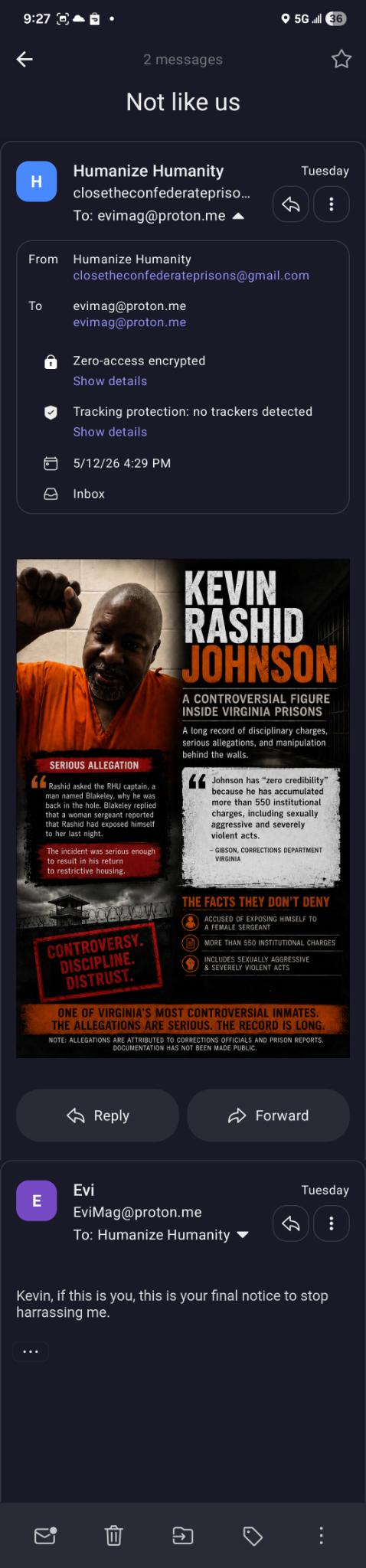

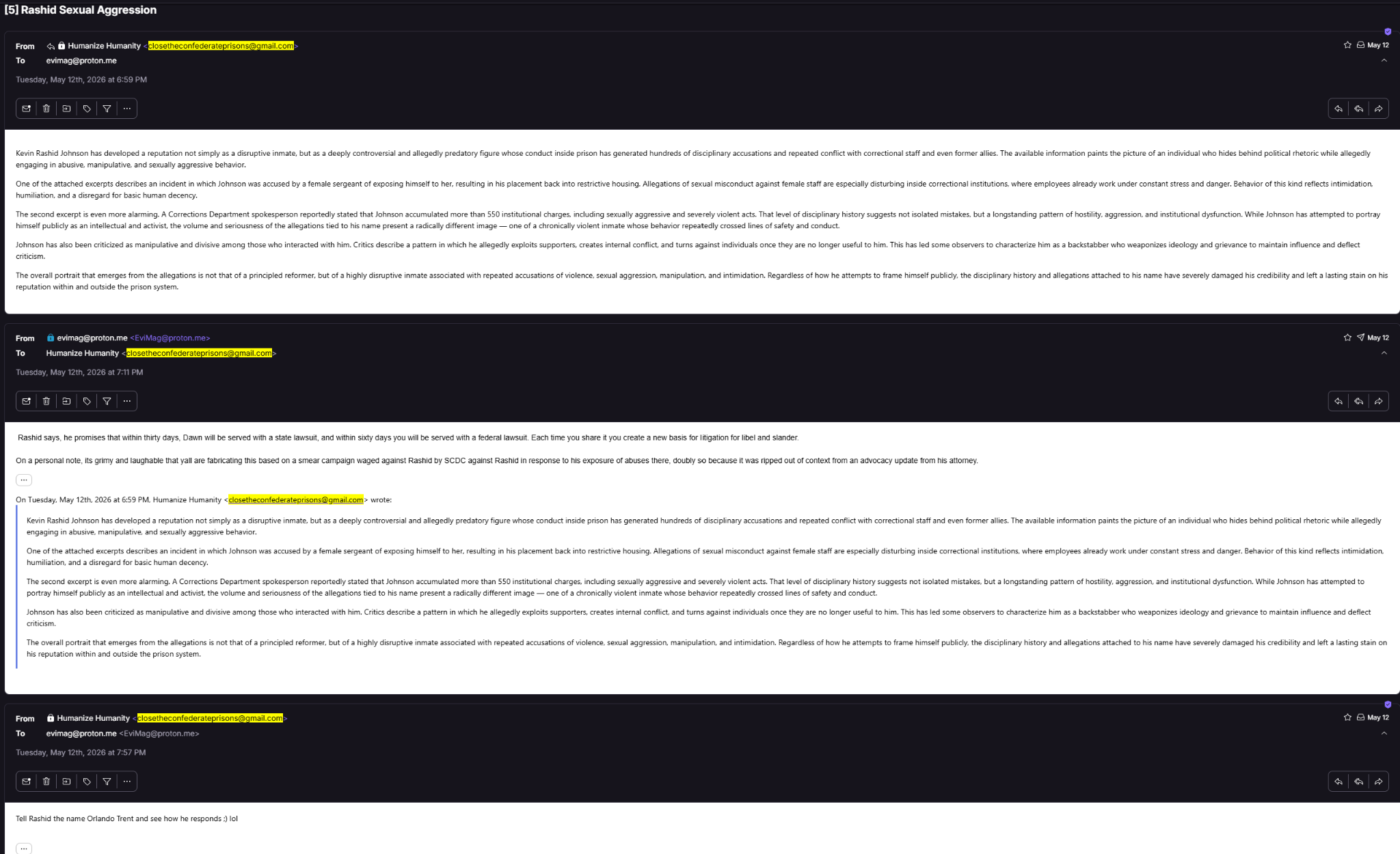
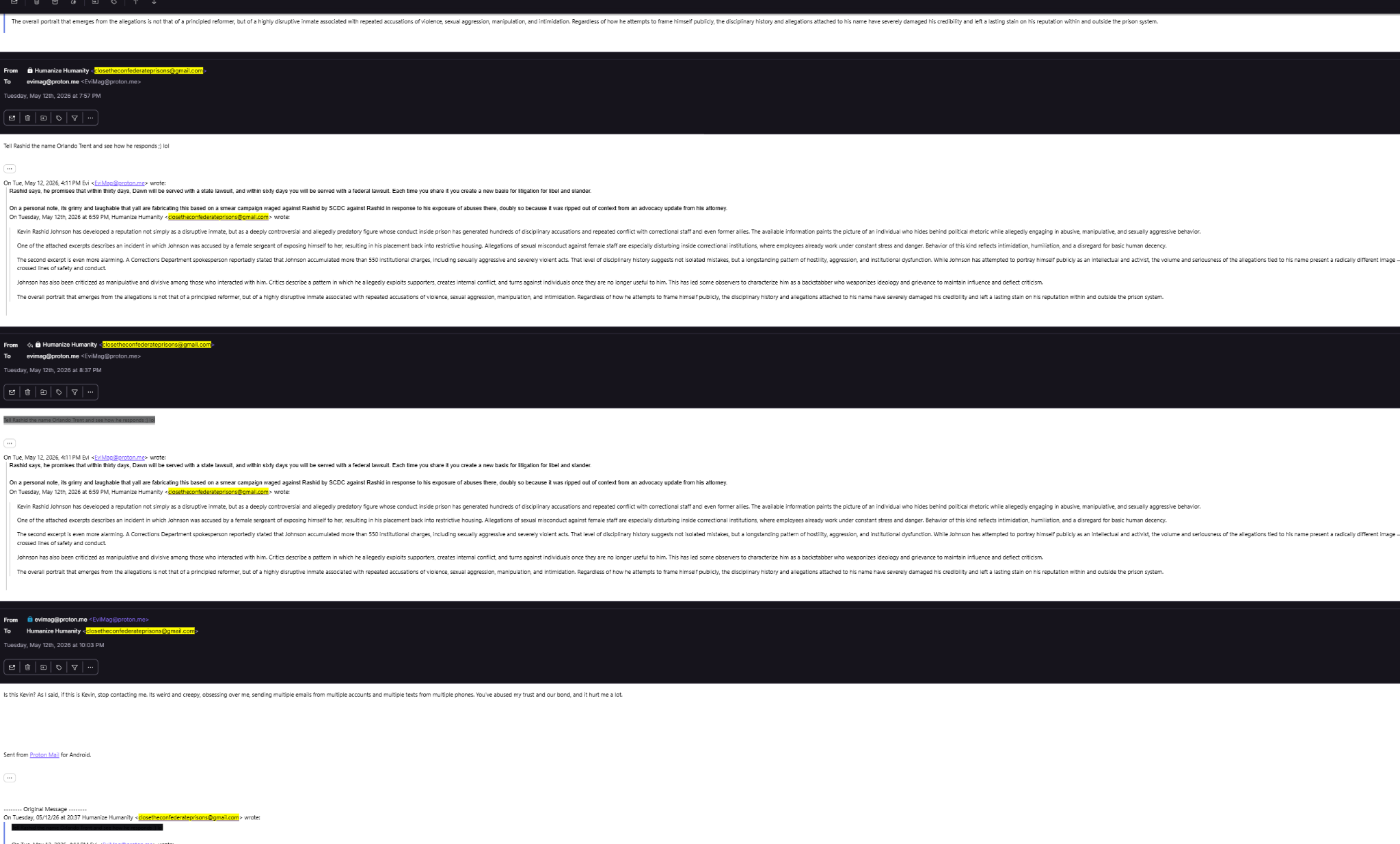
The “Rashid Sexual Aggression” email did not raise a careful concern about a specific incident. It was a sexualized smear email. Its function was not care or accountability. Its function was defamation.
The Orlando Trent bait emails are important because they show the harassment dynamic in real time. During this period, Jeanes and Jeanes-linked accounts repeatedly antagonized Evi through multiple channels while Evi did not initiate contact. Evi’s messages were efforts to stop the contact, stop the smear, and identify the likely source. This exposes Jeanes’s harassment accusation as projection: the side accusing Rashid and Evi of harassment was the side repeatedly threatening, posting, emailing, baiting, and escalating.
Taken together, the evidence supports the conclusion that Jeanes’s attack moved through a connected sockpuppet and linked-account system. Issaquah carried the legal threat. Humanize carried the sexualized smear. Marshawn supplied digital blackface amplification. Strike 13th and Harriet Tubman’s Cat echoed the “taking credit” line through UPROAR listservs. CCCAN became the destination for redirected UPROAR infrastructure. This was not an organic chorus of independent concern. It was a distributed retaliation campaign.
XII. Jeanes and Dawn Redirected UPROAR Facebook Infrastructure
The Facebook group evidence is not a minor admin dispute. It shows the hijacking and repurposing of organizing infrastructure.
Jeanes had offered or allowed a general prison-advocacy group to be repurposed as a UPROAR group. UPROAR then invited members, page followers, loved ones, and supporters into that space for campaign discussion, call/email zap coordination, political education, and internal organizing.
That means the group’s value did not belong simply to whoever held admin buttons. Its value came from UPROAR’s name, organizing labor, member invitations, campaign credibility, and loved-ones trust.
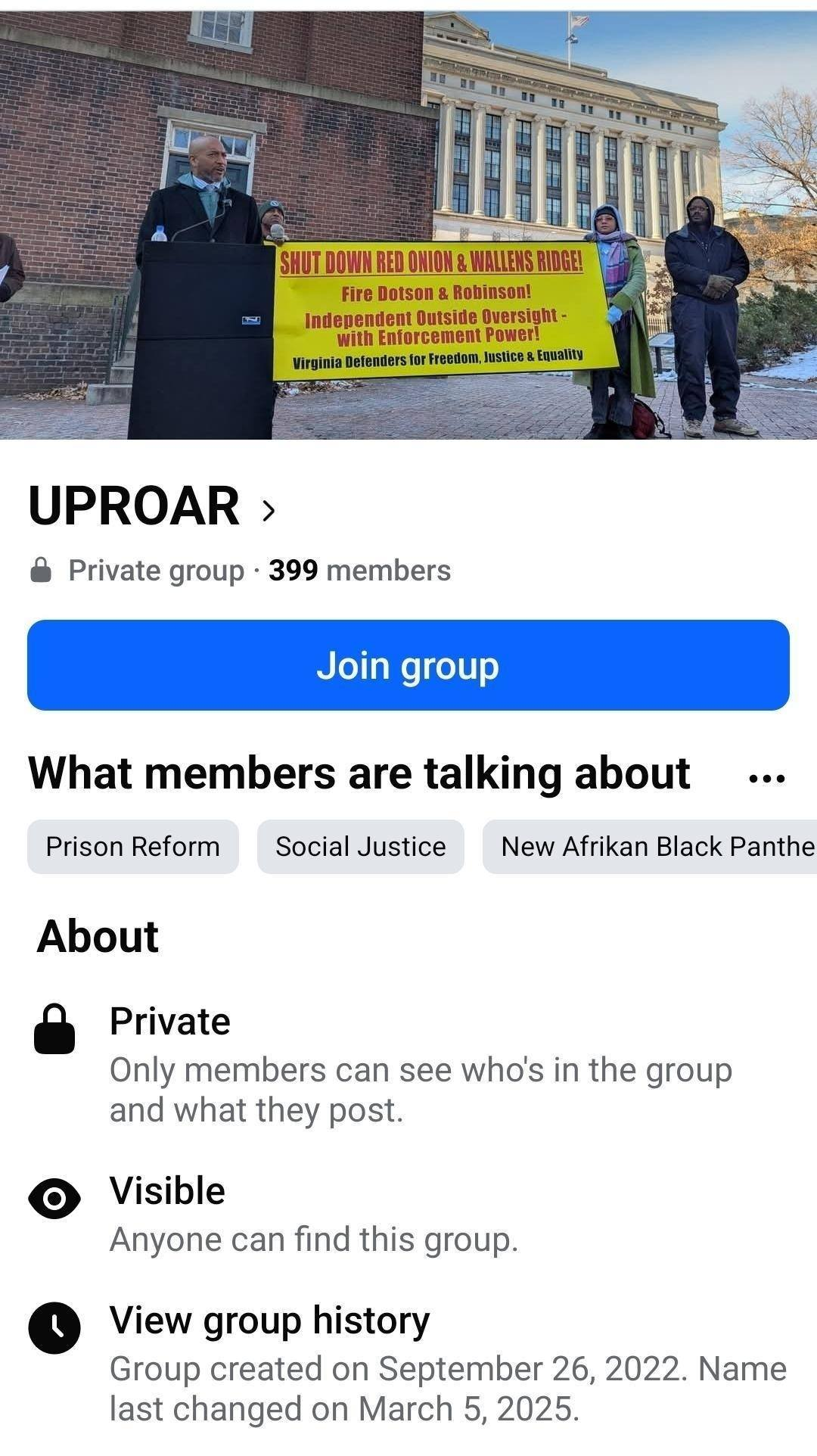
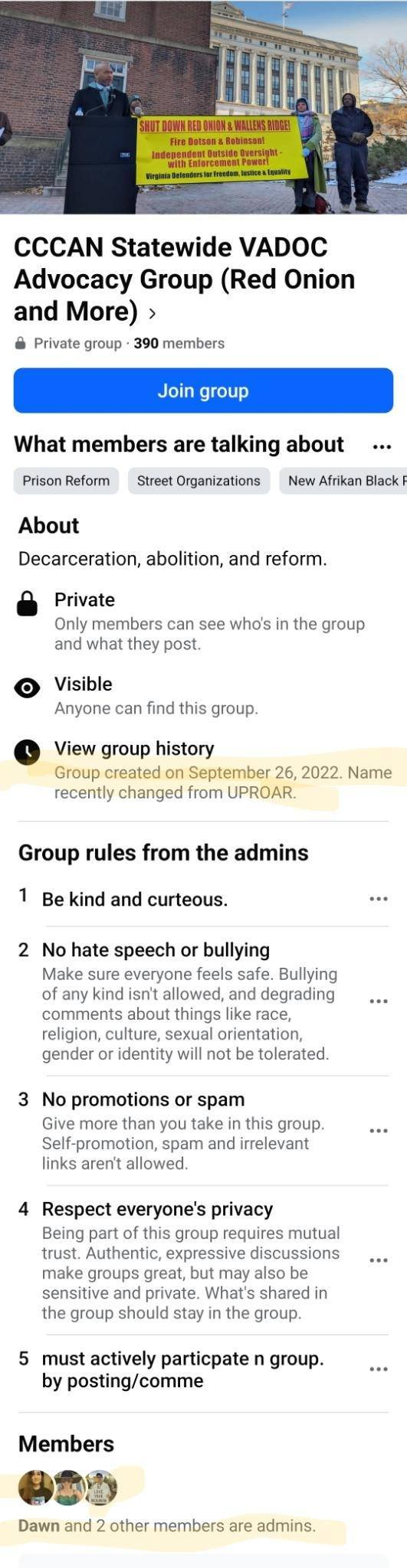
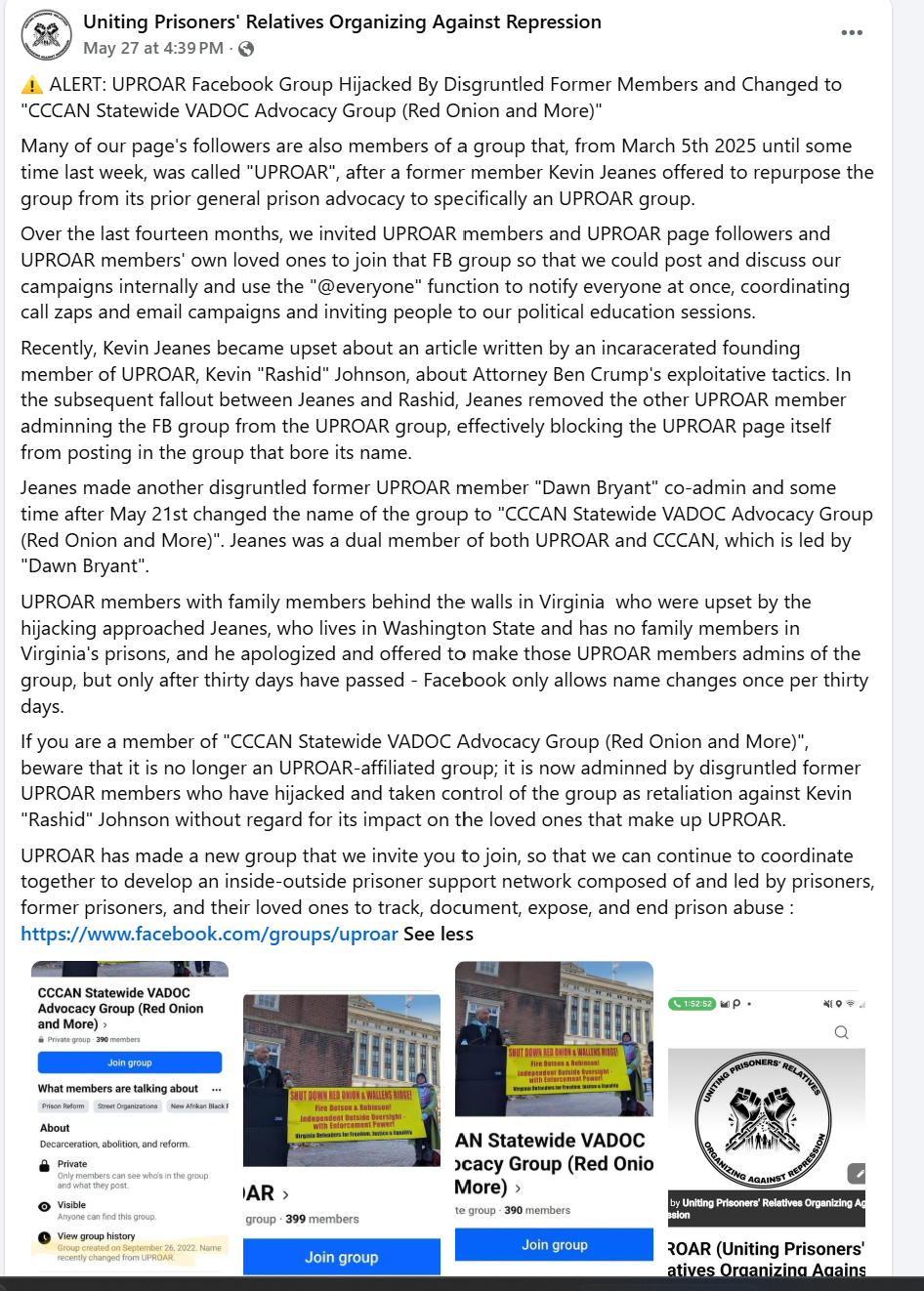
This directly contradicts the “UPROAR is taking credit” smear. Rashid’s Crump/Aubrey article explicitly credited “individual advocates and groups like UPROAR,” not UPROAR alone. Meanwhile, Jeanes and Dawn redirected a UPROAR-branded Facebook group into CCCAN infrastructure after UPROAR’s name, member invitations, and organizing labor had built the space. That was not merely taking credit; it was taking infrastructure.
This was punitive and retaliatory behavior. It also betrayed Jeanes’s promise to Melinda that he would not dishonor the Aubrey family-support space. He did not merely complain about UPROAR; he helped redirect UPROAR-built infrastructure while using Aubrey’s support environment to turn people against Rashid, Evi, and UPROAR.
This harmed members and loved ones who had joined a UPROAR-branded space for UPROAR work. It also redirected an audience built through UPROAR into another political orbit after Jeanes’s conflict with Rashid escalated.
XIII. Jeanes’s Threat, Rashid’s Lawsuit, and SCDC’s Discipline Converged
The convergence is stark. Jeanes threatened that Rashid would “regret it” if Rashid mentioned him. Rashid then published an article about Jeanes. SCDC then used that article as part of a disciplinary charge that placed Rashid in solitary and cut off his ordinary communication channels.

That would be alarming on its own. It becomes even more alarming because Rashid already had a pending federal lawsuit alleging that SCDC and VDOC officials were retaliating against him for journalism, litigation, public complaints, and communication with the outside. In his May 20 statement, Rashid says the hearing officer who found him guilty on the new charge was a defendant in that same lawsuit.
This means SCDC was not disciplining Rashid in a vacuum. According to Rashid, officials he had sued over retaliation for First Amendment activity then punished him for published writing about the same retaliation pattern and about Jeanes.
The incident-report pages and Rashid’s May 20 statement show that SCDC’s May 2026 disciplinary case used both:
- Rashid’s article about Jeanes; and
- UPROAR’s December 2025 article about Rashid’s South Carolina mistreatment.
Rashid described the timing as a tactical attack to lock him down while the campaign against his character and UPROAR’s work proceeded without his ability to respond. He says the hearing officer prevented him from presenting evidence, cut him off when he questioned the charging officer, found him guilty, and imposed solitary plus 100-day restrictions on phone, tablet/messages, canteen, and visitation.
This punishment served a silencing function. It isolated Rashid and cut off his communications while the outside smear unfolded.
The pending civil rights complaint places this in a broader pattern. It alleges that SCDC officials acted to hold Rashid incommunicado, prevent him from exposing conditions through writings and audio recordings, block mail, interfere with attorney communications, and bring his writing output from 4–6 articles per week before transfer to no more than 4 articles in 3 months after transfer.
Jeanes’s campaign was suppressive in its objective effect. It attacked Rashid’s credibility outside while SCDC attacked Rashid’s ability to answer inside.
This convergence is the key public issue. The outside smear cannot be separated from the prison discipline. SCDC was punishing Rashid for writing while Jeanes’s campaign tried to make the writer disappear behind a smear of sexual deviance, manipulation, and dishonesty.
XIV. Racialized Sexual Smear as Carceral Counterinsurgency
The racialized sexual smear was not incidental. It was the ideological center of the attack.
This section should be read together with Rashid’s “Ignore, Isolate, Discredit, Kill” article. There, Rashid identified sexualized slander as a recurring official tactic used to discredit him, incite hostility, and blunt public response to his reporting. Jeanes’s conduct followed that same pattern from outside the prison walls.
SCDC punished Rashid for writing. Jeanes’s smear campaign tried to make the writer disappear behind the image of the predator.
This is a classic carceral and colonial move: turn the Black dissident into a hypersexualized deviant, then treat his speech as danger rather than political testimony. The smear echoes the racist “superpredator” logic used for decades to justify disbelief, containment, and extreme punishment of Black people.
The political function is clear:
Do not investigate the institution.
Do not ask why he is being silenced.
Do not treat him as a journalist, litigant, or organizer.
Treat him as a contaminating danger.
That is how sexual panic becomes counterinsurgency.
Rashid’s article “It Just Ain’t White” also speaks directly to this racialized sexual-smear tradition. In that article, Rashid connects racist denial, the historical violation of Black bodies, and lies about Black men and sexual deviance. That frame matters here because Jeanes’s smear did not merely dispute Rashid’s politics. It used an old prison allegation to recast a Black prison journalist as a sexual threat.
SCDC used that logic to justify isolation and communication suppression. VADOC used the Gibson quote to attack Rashid’s credibility after his reporting exposed Virginia prison abuses. Jeanes used both. He adopted the prison system’s exact allegations and credibility frame, then redeployed them to defend his own reputation, poison a loved-ones support space, and sabotage UPROAR.
The point is not that serious allegations should never be addressed. The point is that serious allegations require serious methods: verification, confidentiality, direct process, concern for affected people, and refusal to launder prison retaliation as fact. Jeanes did the opposite. He used the allegation as a weapon.
XV. Four Modes of Sabotage
1. Narrative sabotage
Jeanes stripped the May 2025 retaliation/PREA context from the South Carolina allegation and laundered prison-generated credibility attacks as if they were neutral fact.
This narrative sabotage was central because it transformed anti-retaliation advocacy material into smear material. The original context was that SCDC had allegedly retaliated against Rashid after he published about SCDC abuse, threatened him over outside calls and media attention, cut off his communication, and reframed his PREA complaint as an exposure allegation. Jeanes removed that context and used the prison’s version as a weapon.
2. Supporter-infrastructure sabotage
Jeanes pushed intimidation and anti-UPROAR messaging into UPROAR’s listserv/supporter space, including the pre-emptive cease-and-desist and the “taking credit” line carried through Strike 13th and Harriet Tubman’s Cat.
This harmed UPROAR’s ability to communicate with supporters. It turned channels built for prisoner-defense work into channels for legal threats and factional attack.
3. Family-space sabotage
Jeanes lied to and misled Aubrey McKay’s family-support space, presenting an old retaliation/PREA allegation as “new,” falsely portraying UPROAR as taking credit for Aubrey’s public attention, and describing remaining UPROAR members as toxic.
This harmed a grieving family-support environment. It redirected attention away from VADOC and Wallens Ridge and toward Jeanes’s reputation defense.
4. Organizational-infrastructure sabotage
Jeanes and Dawn redirected a UPROAR-branded Facebook group into CCCAN infrastructure after UPROAR’s name, audience, and organizing labor had built trust in that space.
This was not ordinary admin conflict. It was the repurposing of collective organizing infrastructure after a political split.
These were not isolated lapses in judgment. They were coordinated modes of sabotage operating across narrative, supporter infrastructure, family-support space, and organizational infrastructure.
XVI. The Crump/Aubrey Article Named the Contradiction Jeanes Then Enacted
The rupture around Jeanes did not begin with a personal disagreement. It began with a political contradiction Rashid had already named in “Attorney Benjamin Crump Exploits Another Lynching Victim’s Family.”
In that article, Rashid criticized Benjamin Crump’s role in the Aubrey McKay case as an example of a broader class relation: the conversion of state violence, Black death, and family grief into legal fees, media control, settlement leverage, and professional status. Rashid’s criticism was not simply that Crump was personally greedy. It was that the settlement process itself protects police and prison abusers, hides evidence from the public, and turns outrage into managed compensation while leaving the machinery of impunity intact.
That critique went to the heart of UPROAR’s purpose. Rashid wrote that Aubrey’s case gained public attention “ONLY because individual advocates and groups like UPROAR persisted in publicly protesting his case.” That sentence explicitly credits people beyond Rashid and beyond UPROAR. It directly refutes Jeanes’s later smear that Rashid and UPROAR were claiming sole credit for the public attention around Aubrey’s death.
Rashid also wrote that, under Crump’s direction, Aubrey’s family and certain advocates were compelled not to discuss new evidence publicly, so that information could be controlled and used in settlement negotiation. Rashid contrasted that with UPROAR’s defining purpose: to bring public light and accountability to prison abuses.
That is why Jeanes’s reaction was so politically revealing. The article did not have to name him. It criticized the advocate-centered relation he was occupying: control over information, control over media strategy, proximity to a grieving family, and authority over how Aubrey’s death would be presented to the public. Jeanes reacted as if Rashid had attacked him because, politically, Rashid had attacked the class role Jeanes had assumed.
Jeanes could have responded as a comrade. He could have answered Rashid’s political argument, clarified facts, struggled over media strategy, or brought the contradiction into collective discussion. Instead, he moved toward punishment and domination. He treated criticism as an attack on his authority, then responded through denunciation, legal threats, prison-narrative laundering, contamination of support spaces, and attacks on collective infrastructure.
The Crump article named the class contradiction. Jeanes’s reaction materialized it.
XVII. Political Conclusion: Comrades, Not Advocates
This situation is not merely interpersonal conflict or “bad advocate behavior.” It shows how unaccountable advocacy can reproduce carceral power inside movements that claim to oppose it.
Rashid’s call to organize what became PAPA and then UPROAR argued that prisoners’ loved ones are often isolated, disbelieved, sent into dead-end appeals to officials, and left powerless unless they unite into an organized pressure force. He warned that career “advocates” and “activists” often have their own agendas, including clout-seeking, nonprofit careerism, proximity to officials, and unwillingness to go against the system. The alternative he proposed was a loved-ones-led pressure organization guided by people who understand the prison system from the inside and underside.
Rashid’s response to Jeanes also referenced his earlier article, “White Privilege and the Revolutionary Struggles of People of Color.” That article argues that oppressed people must lead their own liberation struggles and criticizes privileged white supporters who choose which Black voices to support based on control, comfort, or compliance. That is the political criticism Jeanes refused to engage.
The “comrades, not advocates” conclusion is also grounded in Rashid’s own writing on advocacy. In “Some Thoughts on Advocacy Versus Serving the People in Revolutionary Leadership,” Rashid criticizes advocates who place personal interests before the oppressed and the struggle, seek validation or praise, maneuver for special control, and cannot take genuine criticism. That framework describes the political meaning of Jeanes’s conduct here.
Jeanes’s conduct exposes the contradiction between:
vs.
advocacy as reputation, access, control, and moral capital
When challenged, Jeanes did not accept correction. He protected his own reputation by laundering prison narratives, threatening legal action, poisoning a grieving family-support space, attacking supporter infrastructure, and redirecting organizing infrastructure.
A comrade under criticism asks: What serves the struggle?
A reputation-manager asks: How do I survive this criticism?
Jeanes chose the second path.
This distinction matters because UPROAR is not an abstract brand. It is made up of loved ones, incarcerated people, formerly incarcerated people, and supporters trying to fight prison abuse while facing grief, fear, retaliation, and institutional deception. When an advocate uses that movement’s spaces to protect their own reputation, they do not simply harm an individual. They weaken the collective capacity of oppressed people to fight back.
The prison system benefits from this kind of contradiction. It benefits when prisoner journalists are discredited, loved-ones groups fracture, advocates repeat institutional allegations, supporters fear reputational contamination, family spaces are poisoned, communication infrastructure is captured, and the prisoner is cut off from answering.
The deeper lesson is not that movements need better advocates. The lesson is that prisoners and loved ones need comrades: people who serve under accountability, accept correction, refuse state narratives, protect collective infrastructure, and defend the capacity of the oppressed to fight back.
Conclusion
SCDC isolated an incarcerated Black journalist, charged him for published writing, and cut off his communications.
Jeanes used an old retaliation-linked prison allegation to smear that journalist as sexually predatory, manipulative, and discredited.
Jeanes did not simply disagree with Rashid. He used the same allegation SCDC had used, for the same purpose SCDC had used it: to discredit Rashid’s criticism of the actor being criticized.
SCDC used the allegation after Rashid criticized SCDC.
VADOC used the Gibson “zero credibility” quote to discredit Rashid after he exposed Virginia prison abuses.
Jeanes used both after Rashid criticized Jeanes.
Jeanes and Dawn knew the allegation’s actual context. They knew it followed Rashid’s article exposing SCDC abuse. They knew Rashid had framed the underlying incident as a PREA violation. They knew SCDC had threatened him over outside pressure. They knew he had been placed in RHU and cut off from phone and tablet access. They knew UPROAR was asked to intensify pressure, not retreat. Jeanes’s later use of that allegation as a “new” sexual-misconduct charge was deliberate context-stripping.
Jeanes then used multiple channels of sabotage: legal threats, family-space poisoning, listserv attacks, sockpuppet and linked account identities, sexualized smear emails, digital blackface amplification, and Facebook infrastructure hijacking.
Jeanes did not merely repeat a prison allegation; he weaponized the very retaliation narrative Rashid was already suing SCDC and VDOC over, using it to discredit Rashid after Rashid criticized him. He did not merely adopt the prison system’s method. He adopted its exact allegations, its exact credibility frame, and its exact racialized smear logic. By boosting VADOC and SCDC’s credibility, he tried to lower Rashid’s credibility — and by lowering Rashid’s credibility, he tried to raise his own.
The evidence supports the conclusion that Jeanes’s campaign was retaliatory, suppressive, abusive, defamatory, and harassing. It harmed Rashid and Evi, but also UPROAR members, loved ones, listserv supporters, and the broader organizing infrastructure built to defend prisoners from precisely this kind of retaliation.
Take action: Free Rashid from retaliatory solitary and bring him home to Virginia
Evidence cited in this report is organized by exhibit number. Readers can download the full chronological evidence matrix, supporting image archive, Rashid’s pending civil rights complaint, and Rashid’s recorded May 20 statement here:
Download the chronological evidence matrix (.xlsx)
Download the supporting image archive (.zip)
Download Rashid’s pending civil rights complaint (.pdf)
Listen to Rashid’s May 20, 2026 recorded statement (.mp3)
A handwritten version of the complaint is also archived at: original handwritten complaint PDF.